BMI Calculator – Complete Guide to Body Mass Index for Adults
Have you ever wondered if your weight is healthy for your height? Or maybe your doctor mentioned your BMI and you had no idea what that number meant?
I remember my first annual health checkup after college. The doctor said my BMI was 26.5 and told me I was overweight. I was confused. I did not feel overweight. I exercised regularly. But when I got home and learned more about BMI, I understood. My BMI was slightly above normal, and even though I was active, my eating habits needed improvement.
That checkup was a wake-up call. I started paying attention to my diet. Six months later, my BMI was 23.8, and I felt better than ever.
This guide will teach you everything you need to know about BMI. What it means, how to calculate it, what the categories are, and most importantly, what to do with your results.
Quick access: Use our free BMI calculator here
What is BMI? Simple Answer
BMI stands for Body Mass Index. It is a number calculated from your weight and height. It gives a rough estimate of whether you are underweight, at a healthy weight, overweight, or obese.
Simple example:
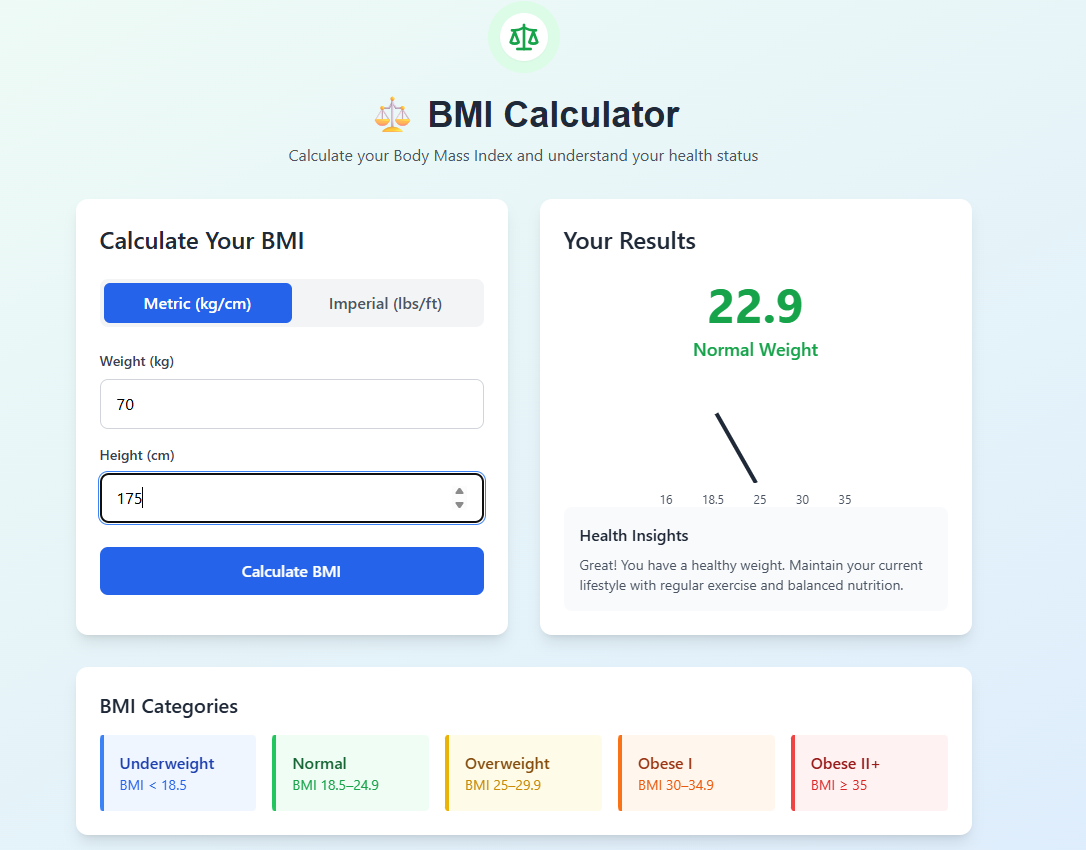
- Person A: Weight 70 kg, Height 1.75 m → BMI = 22.9 (healthy weight)
- Person B: Weight 90 kg, Height 1.75 m → BMI = 29.4 (overweight)
- Person C: Weight 50 kg, Height 1.75 m → BMI = 16.3 (underweight)
BMI is not a perfect measure, but it is a useful starting point for understanding your weight status.
Why BMI Matters for Your Health
BMI is important because it is linked to health risks. Studies show that people with very high or very low BMI have higher risks of certain diseases.
Health risks of high BMI (overweight or obese):
- Heart disease
- Type 2 diabetes
- High blood pressure
- High cholesterol
- Sleep apnea
- Joint problems (knee and hip pain)
- Certain cancers
- Stroke
Health risks of low BMI (underweight):
- Weakened immune system
- Osteoporosis (weak bones)
- Anemia
- Fertility problems
- Nutritional deficiencies
- Muscle loss
For people with normal BMI (18.5-24.9):
- Lower risk of weight-related diseases
- Better overall health outcomes
- Higher energy levels
- Better mobility as you age
BMI Formula – How to Calculate BMI Manually
You can calculate BMI yourself using simple formulas. Here is how.
Metric Formula (kilograms and meters)
Formula: BMI = weight (kg) ÷ height² (m²)
Step by step example:
Weight = 70 kg Height = 1.75 meters
Step 1: Square the height: 1.75 × 1.75 = 3.0625 Step 2: Divide weight by squared height: 70 ÷ 3.0625 = 22.86
Answer: BMI = 22.9 (rounded)
Metric with Centimeters (if you know your height in cm)
If you know your height in centimeters (e.g., 175 cm), convert to meters first: 175 ÷ 100 = 1.75 m.
Formula with cm: BMI = weight (kg) ÷ (height in cm ÷ 100)²
Imperial Formula (pounds and inches)
Formula: BMI = 703 × weight (lbs) ÷ height² (in²)
Step by step example:
Weight = 154 lbs Height = 69 inches (5 feet 9 inches)
Step 1: Square the height: 69 × 69 = 4761 Step 2: Divide weight by squared height: 154 ÷ 4761 = 0.03234 Step 3: Multiply by 703: 0.03234 × 703 = 22.73
Answer: BMI = 22.7 (rounded)
Quick Reference BMI Table
Use this table to estimate your BMI without calculating.
| Height | Healthy weight (BMI 18.5-24.9) | Overweight (BMI 25-29.9) | Obese (BMI 30+) |
|---|---|---|---|
| 150 cm (4'11") | 42-56 kg | 56-67 kg | 68+ kg |
| 155 cm (5'1") | 45-60 kg | 60-72 kg | 73+ kg |
| 160 cm (5'3") | 48-64 kg | 64-77 kg | 78+ kg |
| 165 cm (5'5") | 51-68 kg | 68-82 kg | 83+ kg |
| 170 cm (5'7") | 54-72 kg | 72-87 kg | 88+ kg |
| 175 cm (5'9") | 57-76 kg | 76-92 kg | 93+ kg |
| 180 cm (5'11") | 60-81 kg | 81-97 kg | 98+ kg |
| 185 cm (6'1") | 64-85 kg | 85-103 kg | 104+ kg |
| 190 cm (6'3") | 68-90 kg | 90-108 kg | 109+ kg |
BMI Categories – What Your Number Means
The World Health Organization (WHO) defines these BMI categories for adults.
Underweight (BMI below 18.5)
| BMI Range | Category |
|---|---|
| Below 16.0 | Severe underweight |
| 16.0 - 16.9 | Moderate underweight |
| 17.0 - 18.4 | Mild underweight |
| 18.5 | Lower limit of healthy weight |
What it means: You may not be getting enough nutrients. This can weaken your immune system and lead to bone density loss.
What to do: Consult a doctor or dietitian. Focus on nutrient-dense foods and healthy weight gain strategies.
Normal Weight (BMI 18.5 to 24.9)
| BMI Range | Category |
|---|---|
| 18.5 - 22.9 | Healthy weight (lower range) |
| 23.0 - 24.9 | Healthy weight (upper range) |
What it means: You are at a healthy weight for your height. Your risk of weight-related diseases is lower.
What to do: Maintain your weight with balanced nutrition and regular physical activity.
Overweight (BMI 25.0 to 29.9)
| BMI Range | Category |
|---|---|
| 25.0 - 27.4 | Overweight (mild) |
| 27.5 - 29.9 | Overweight (moderate) |
What it means: You have excess weight that could lead to health problems over time.
What to do: Small changes can help. Reduce portion sizes, increase physical activity, and limit processed foods.
Obese (BMI 30 and above)
| BMI Range | Category |
|---|---|
| 30.0 - 34.9 | Obese Class I |
| 35.0 - 39.9 | Obese Class II |
| 40.0 and above | Obese Class III (severe obesity) |
What it means: Your weight significantly increases your risk of serious health conditions.
What to do: Consult a healthcare professional. They can help create a safe weight loss plan.
BMI Chart – Visual Reference
Here is a complete BMI chart for different heights and weights.
| Weight (kg) | 150 cm | 160 cm | 170 cm | 175 cm | 180 cm | 185 cm |
|---|---|---|---|---|---|---|
| 45 kg | 20.0 | 17.6 | 15.6 | 14.7 | 13.9 | 13.1 |
| 50 kg | 22.2 | 19.5 | 17.3 | 16.3 | 15.4 | 14.6 |
| 55 kg | 24.4 | 21.5 | 19.0 | 18.0 | 17.0 | 16.1 |
| 60 kg | 26.7 | 23.4 | 20.8 | 19.6 | 18.5 | 17.5 |
| 65 kg | 28.9 | 25.4 | 22.5 | 21.2 | 20.1 | 19.0 |
| 70 kg | 31.1 | 27.3 | 24.2 | 22.9 | 21.6 | 20.5 |
| 75 kg | 33.3 | 29.3 | 26.0 | 24.5 | 23.1 | 21.9 |
| 80 kg | 35.6 | 31.3 | 27.7 | 26.1 | 24.7 | 23.4 |
| 85 kg | 37.8 | 33.2 | 29.4 | 27.8 | 26.2 | 24.8 |
| 90 kg | 40.0 | 35.2 | 31.1 | 29.4 | 27.8 | 26.3 |
| 95 kg | 42.2 | 37.1 | 32.9 | 31.0 | 29.3 | 27.8 |
| 100 kg | 44.4 | 39.1 | 34.6 | 32.7 | 30.9 | 29.2 |
Color guide for the chart:
- Green (18.5-24.9) = Healthy weight
- Yellow (25-29.9) = Overweight
- Orange (30-34.9) = Obese Class I
- Red (35+) = Obese Class II+
- Blue (below 18.5) = Underweight
BMI for Men vs BMI for Women
The BMI formula and categories are the same for adult men and women. However, healthy body fat percentages differ between men and women.
Typical healthy body fat percentage:
- Men: 10-20%
- Women: 18-28%
Why this matters: A man and woman with the same BMI may have different body fat levels. Women naturally have more body fat than men.
Example:
- Man: 180 cm, 80 kg → BMI 24.7 (healthy weight)
- Woman: 180 cm, 80 kg → BMI 24.7 (healthy weight)
Both have the same BMI, but the woman likely has a higher body fat percentage. This is normal and healthy.
BMI for Athletes and Bodybuilders
BMI has a major limitation: it does not distinguish between muscle and fat.
The problem: Muscle weighs more than fat. A muscular athlete can have a high BMI but very low body fat.
Real example:
- Professional rugby player: 185 cm, 110 kg
- BMI calculation: 110 ÷ (1.85²) = 32.1
- BMI category: Obese Class I
- Actual body fat: 12% (very fit)
What this means: If you are athletic or muscular, BMI may overestimate your body fat. A body fat measurement would be more accurate for you.
BMI for Seniors (Older Adults)
For adults over 65, the healthy BMI range may be slightly higher.
Research suggests:
- Healthy BMI for seniors: 23 to 27
- Below 23 may indicate malnutrition risk
- Above 27 may indicate obesity risk
Why the difference: As we age, we lose muscle mass. A slightly higher BMI may indicate adequate nutrition and muscle preservation.
BMI for Children and Teens
BMI for children and teens is calculated the same way, but interpreted differently.
Instead of fixed categories, children's BMI uses percentiles:
- Below 5th percentile = Underweight
- 5th to 84th percentile = Healthy weight
- 85th to 94th percentile = Overweight
- 95th percentile and above = Obese
Why percentiles: Children grow at different rates. Comparing to other children of the same age and sex is more accurate.
Note: The BMI calculator on our site is for adults (18+). For children, consult your pediatrician.
BMI During Pregnancy
BMI is not accurate during pregnancy. Pregnant women naturally gain weight to support the baby.
Pre-pregnancy BMI categories:
| Pre-pregnancy BMI | Recommended weight gain |
|---|---|
| Underweight (<18.5) | 12.5-18 kg |
| Normal (18.5-24.9) | 11.5-16 kg |
| Overweight (25-29.9) | 7-11.5 kg |
| Obese (30+) | 5-9 kg |
Important: Do not track BMI during pregnancy. Focus on healthy eating and your doctor's guidance.
BMI vs Body Fat Percentage
BMI and body fat percentage measure different things.
| Measure | What it measures | Accuracy | Best for |
|---|---|---|---|
| BMI | Weight relative to height | Good for general population | Quick screening |
| Body fat % | Actual fat vs muscle | More accurate for individuals | Fitness tracking |
When BMI is sufficient:
- General health screening
- Population studies
- Most non-athletic adults
When you need body fat percentage:
- Athletes and bodybuilders
- People with high muscle mass
- Tracking fitness progress
How to Use Our BMI Calculator
Our BMI calculator makes it easy to check your BMI.
Step 1: Choose your unit system (Metric or Imperial)
Step 2: Enter your weight
- Metric: kilograms (kg)
- Imperial: pounds (lbs)
Step 3: Enter your height
- Metric: centimeters (cm) or meters (m)
- Imperial: feet and inches
Step 4: Click Calculate
You will see:
- Your BMI number
- Your weight category (Underweight, Normal, Overweight, Obese)
- Color-coded gauge showing where you fall
- Health insights and recommendations
All calculations happen in your browser. Your data never leaves your device.
Real-Life Examples of BMI Calculation
Example 1: Healthy Weight Individual
Person: 32-year-old woman, 165 cm, 58 kg
Calculation: 58 ÷ (1.65²) = 58 ÷ 2.7225 = 21.3
BMI: 21.3 (Normal weight)
Assessment: Healthy weight. Continue balanced diet and regular exercise.
Example 2: Overweight Individual
Person: 45-year-old man, 175 cm, 85 kg
Calculation: 85 ÷ (1.75²) = 85 ÷ 3.0625 = 27.8
BMI: 27.8 (Overweight)
Assessment: Overweight. Consider reducing portion sizes and increasing daily steps.
Example 3: Obese Individual
Person: 55-year-old woman, 160 cm, 85 kg
Calculation: 85 ÷ (1.60²) = 85 ÷ 2.56 = 33.2
BMI: 33.2 (Obese Class I)
Assessment: Obese. Consult a doctor for a safe weight loss plan.
Example 4: Underweight Individual
Person: 25-year-old man, 180 cm, 55 kg
Calculation: 55 ÷ (1.80²) = 55 ÷ 3.24 = 17.0
BMI: 17.0 (Underweight)
Assessment: Underweight. Consult a dietitian for healthy weight gain strategies.
Limitations of BMI (Important to Know)
BMI is a useful screening tool, but it has limitations.
Limitation 1: Does Not Measure Body Fat
BMI cannot tell the difference between muscle, bone, and fat.
Example: A bodybuilder and an obese person could have the same BMI but completely different body compositions.
Limitation 2: Does Not Show Fat Distribution
Where you carry fat matters. Belly fat (visceral fat) is more dangerous than fat on hips or thighs. BMI does not capture this.
Limitation 3: Not Accurate for All Ethnicities
Some ethnic groups have different body fat percentages at the same BMI.
Example: Asian populations may have higher health risks at lower BMIs. Some experts recommend lower BMI cutoffs for Asian adults.
Limitation 4: Not Accurate for Athletes
As mentioned earlier, athletes with high muscle mass may have high BMI but low body fat.
Limitation 5: Not Accurate During Pregnancy
Pregnancy weight gain is healthy and necessary. Do not use BMI during pregnancy.
Limitation 6: Not Accurate for Children
Children's body composition changes as they grow. Use pediatric-specific charts.
How to Improve Your BMI (If Needed)
If You Need to Lower Your BMI (Overweight or Obese)
Diet changes:
- Reduce portion sizes
- Eat more vegetables and fruits
- Choose whole grains over refined grains
- Limit sugary drinks and processed foods
- Drink water before meals
Exercise changes:
- Start with walking 30 minutes daily
- Add strength training 2-3 times per week
- Aim for 150 minutes of moderate activity weekly
- Take stairs instead of elevator
- Park farther from entrances
Lifestyle changes:
- Get 7-8 hours of sleep nightly
- Reduce stress
- Keep a food diary
- Weigh yourself weekly (not daily)
Safe weight loss rate: 0.5 to 1 kg per week (1-2 lbs). Faster weight loss is often not sustainable.
If You Need to Increase Your BMI (Underweight)
Diet changes:
- Eat more frequently (5-6 small meals daily)
- Add healthy fats (nuts, avocados, olive oil)
- Choose nutrient-dense foods
- Drink smoothies with protein powder
- Add cheese, nuts, or seeds to meals
Exercise changes:
- Focus on strength training to build muscle
- Reduce excessive cardio
- Work with a trainer if possible
Important: If you are underweight despite eating well, consult a doctor to rule out underlying conditions.
BMI and Health Insurance
Some health insurance companies use BMI to assess risk and determine premiums.
How BMI affects insurance:
- Normal BMI: Standard rates
- High BMI: Higher premiums (due to increased health risks)
- Very low BMI: May also affect rates
What you can do: If you have a high BMI due to muscle mass (athlete), ask your insurance company if they accept alternative measurements like body fat percentage.
Frequently Asked Questions
Q: How to calculate BMI manually?
A: For metric: BMI = weight (kg) ÷ height² (m²). For imperial: BMI = 703 × weight (lbs) ÷ height² (in²). Use our calculator for instant results.
Q: What is a normal BMI range?
A: A normal BMI is between 18.5 and 24.9. Below 18.5 is underweight. Above 25 is overweight. Above 30 is obese.
Q: What is the best BMI calculator online?
A: Our BMI calculator is free, supports both metric and imperial units, and provides instant results with health insights.
Q: Is BMI accurate for everyone?
A: No. BMI does not work well for athletes, bodybuilders, pregnant women, children, or seniors. It is best for the general adult population.
Q: What BMI is considered obese?
A: BMI of 30 or above is considered obese. Class I obesity is 30-34.9. Class II is 35-39.9. Class III is 40+.
Q: What BMI is considered overweight?
A: BMI between 25 and 29.9 is considered overweight.
Q: What BMI is considered underweight?
A: BMI below 18.5 is considered underweight.
Q: Can BMI be wrong?
A: Yes. BMI can be wrong for muscular individuals (shows overweight when they are fit) and for older adults (may show normal when they have low muscle mass).
Q: What is a good BMI for a woman?
A: The same as for men: 18.5 to 24.9. Women naturally have higher body fat, but the BMI range is the same.
Q: What is a good BMI for a man?
A: 18.5 to 24.9. However, men with high muscle mass may have higher BMIs while being healthy.
Q: How to lower BMI quickly?
A: Safe weight loss is 0.5-1 kg per week. Combine diet changes (portion control, whole foods) with exercise (walking, strength training).
Q: Is BMI calculated differently for men and women?
A: No. The same formula and categories apply to both adult men and women.
Q: Does age affect BMI interpretation?
A: For adults 18-65, the same categories apply. For seniors (65+), a slightly higher BMI (23-27) may be healthier.
Q: Does the BMI calculator store my data?
A: No. All calculations happen in your browser. Your data never leaves your device.
Q: How often should I check my BMI?
A: Once a month is enough for tracking progress. Daily measurements show normal fluctuations and can be discouraging.
My Final Advice
After learning about BMI and using it to track my own health, here is what I have learned.
Use BMI as a screening tool, not a diagnosis. It tells you if you might have a weight problem, but it does not tell the whole story.
Combine BMI with other measurements. Waist circumference, body fat percentage, and how your clothes fit give a fuller picture.
Do not obsess over the number. A BMI of 25.1 (overweight) is not dramatically different from 24.9 (normal). Look at trends over time, not single measurements.
Focus on habits, not just the number. Eating well, exercising regularly, sleeping enough, and managing stress matter more than any single number.
Talk to your doctor. If your BMI is very high or very low, or if you have concerns, consult a healthcare professional. They can give personalized advice.
And finally, use a good BMI calculator. Our tool gives you instant results, clear categories, and helpful insights. It is free and works on any device.
Calculate Your BMI Now – Free Tool
Have questions about your BMI or weight management? Leave a comment below. I try to answer every one.
Tags: bmi calculator, how to calculate bmi, body mass index, bmi formula, bmi chart for adults, bmi categories underweight normal overweight obese, calculate bmi metric formula, calculate bmi imperial formula, what is a healthy bmi, bmi for men, bmi for women, bmi limitations, bmi vs body fat percentage, bmi for athletes, bmi for seniors, bmi during pregnancy, weight status categories, bmi and health risks, bmi and heart disease, bmi and diabetes, bmi calculator online free, bmi calculator with metric and imperial, bmi visualizer, bmi gauge, bmi health insights, healthy weight range, underweight health risks, overweight health risks, obesity health risks, how to lower bmi, how to increase bmi