How to Calculate Take-Home Salary After Deductions – Complete Guide with Free Salary Calculator
Have you ever received a job offer with a great salary but felt confused about what you will actually take home every month? Or maybe you looked at your payslip and wondered where a large chunk of your money went?
I remember my first job offer. The recruiter told me the annual package was ₹6,00,000. I was excited. I calculated ₹50,000 per month in my head. When my first payslip arrived, my bank account showed only ₹42,000. I panicked. Where did ₹8,000 go?
That is when I learned about deductions. Income tax. Provident fund. Professional tax. Each one chipping away at my gross salary. I had no idea these existed. Nobody explained them to me.
After years of working with payroll professionals and helping thousands of employees understand their salary structure, I created this guide. No more confusion. No more surprises. Just clear explanations and a tool that does all the math for you.
Quick access: Use our free salary calculator here
What is a Salary Calculator? Simple Answer
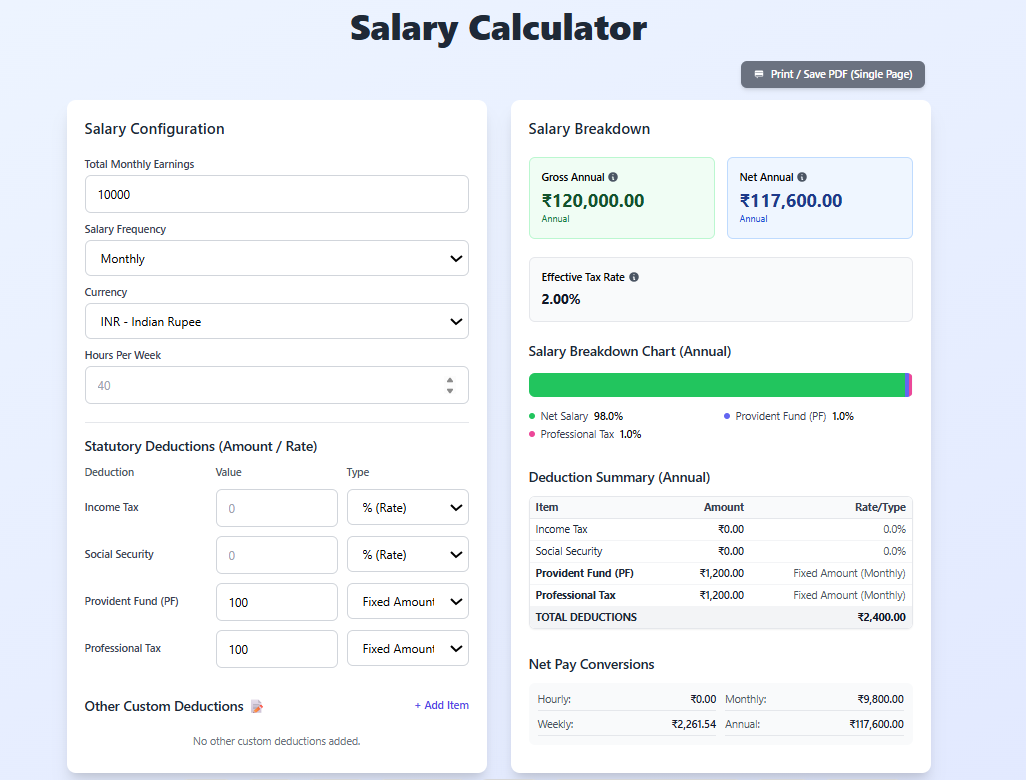
A salary calculator (also called a take-home pay calculator) shows you exactly how much money you will receive after all deductions are taken from your gross salary.
Gross Salary: The total amount you earn before any deductions Net Salary (Take-Home Pay): The amount that actually reaches your bank account Deductions: Money subtracted from gross salary for taxes, retirement funds, insurance, and other items
Simple example:
If your monthly gross salary is ₹50,000:
- Income Tax: ₹3,000 (estimated)
- Provident Fund (PF): ₹1,800
- Professional Tax: ₹200
- Total deductions: ₹5,000
- Net salary (take-home): ₹45,000
That ₹5,000 difference matters. Over a year, that is ₹60,000. That could be a vacation, an emergency fund, or loan payments.
Why Most People Get Salary Calculation Wrong
After helping thousands of employees understand their payslips, I have seen the same mistakes over and over.
Mistake 1: Assuming gross salary equals take-home pay
This is the mistake I made. Many job seekers negotiate based on gross salary but plan their budget based on net salary. The difference can be 15-30% of your income.
Mistake 2: Not understanding the difference between monthly and annual deductions
Some deductions (like professional tax) are monthly. Some (like income tax) are calculated annually but deducted monthly. If you only look at monthly numbers, you might miss the bigger picture.
Mistake 3: Forgetting about variable components
Your salary may have bonuses, allowances, or overtime. These are often taxed differently than your base salary. A good salary calculator accounts for these.
Mistake 4: Using outdated tax rates
Tax laws change every year. Old tax regimes, new tax regimes, surcharges, cess. It gets complicated quickly.
Mistake 5: Ignoring salary frequency when comparing offers
Is a $30 per hour job better than a $60,000 annual salary? You need to convert to the same frequency to compare. Our calculator does this automatically.
Mistake 6: Not accounting for employer contributions
Some calculators show only employee deductions. But employer PF contributions are part of your cost to company (CTC). Understanding both helps you evaluate job offers better.
How to Calculate Net Salary Manually – Step by Step
Let me show you how to calculate take-home salary without a calculator. Then you can use our tool to verify your answer.
Step 1: Determine your gross annual salary
Example: Monthly gross = ₹50,000 Annual gross = ₹50,000 × 12 = ₹6,00,000
Step 2: Identify applicable deductions
Common statutory deductions in India:
Provident Fund (PF):
- Employee contribution: 12% of basic salary
- Basic salary is typically 40-50% of gross
- Example: If basic is ₹20,000, PF = ₹20,000 × 0.12 = ₹2,400 per month
Professional Tax (PT):
- Varies by state
- Typically ₹200-₹250 per month
- Annual: ₹2,400-₹3,000
Income Tax:
- Depends on tax regime (old or new)
- Slab rates from 0% to 30%
- Standard deduction of ₹50,000 (old regime)
Step 3: Calculate annual deductions
Using our example (monthly gross ₹50,000):
Assuming basic salary = ₹25,000 (50% of gross):
- PF (employee): ₹25,000 × 12% = ₹3,000 per month × 12 = ₹36,000 annually
- Professional tax: ₹200 per month × 12 = ₹2,400 annually
Income tax calculation (new regime, assuming ₹6,00,000 annual gross):
- Up to ₹3,00,000: 0% = ₹0
- ₹3,00,001 to ₹6,00,000: 5% = ₹15,000
- Total tax = ₹15,000
- Add 4% health and education cess = ₹600
- Total income tax = ₹15,600 annually (₹1,300 per month)
Step 4: Calculate total annual deductions and net salary
Total annual deductions = PF ₹36,000 + Professional Tax ₹2,400 + Income Tax ₹15,600 = ₹54,000
Annual net salary = ₹6,00,000 - ₹54,000 = ₹5,46,000
Monthly net salary = ₹5,46,000 ÷ 12 = ₹45,500
Step 5: Calculate effective tax rate
Effective tax rate = (Total deductions ÷ Gross annual salary) × 100 = (₹54,000 ÷ ₹6,00,000) × 100 = 9%
Final manual answer:
- Gross monthly: ₹50,000
- Net monthly (take-home): ₹45,500
- Total annual deductions: ₹54,000
- Effective tax rate: 9%
The easier way: Our salary calculator gives you all of this instantly with no manual math errors.
Salary Calculator for Different Scenarios
Salary Calculator for Job Offer Comparison
You have two job offers. One is hourly. One is annual. How do you compare?
Scenario:
- Offer A: $35 per hour, 40 hours per week
- Offer B: $70,000 annual salary
Our calculator shows:
- Offer A annual gross: $35 × 40 × 52 = $72,800
- After estimated taxes (25%): Net ~ $54,600
- Offer B after estimated taxes: Net ~ $52,500
Winner: Offer A by about $2,100 annually
Take-Home Pay Calculator for Budget Planning
You are planning your monthly budget. You need to know exactly what hits your bank account.
Scenario: Monthly gross ₹75,000
Our calculator shows breakdown:
- Income tax: ₹6,500 per month
- PF deduction: ₹4,500 per month
- Professional tax: ₹200 per month
- Total monthly deductions: ₹11,200
- Monthly take-home: ₹63,800
Now you can budget: Rent ₹20,000, Food ₹10,000, Transport ₹5,000, Savings ₹15,000, Entertainment ₹5,000, Remaining ₹8,800 for other expenses.
Income Tax Calculator for Tax Planning
Want to know how much tax you will pay before the financial year ends?
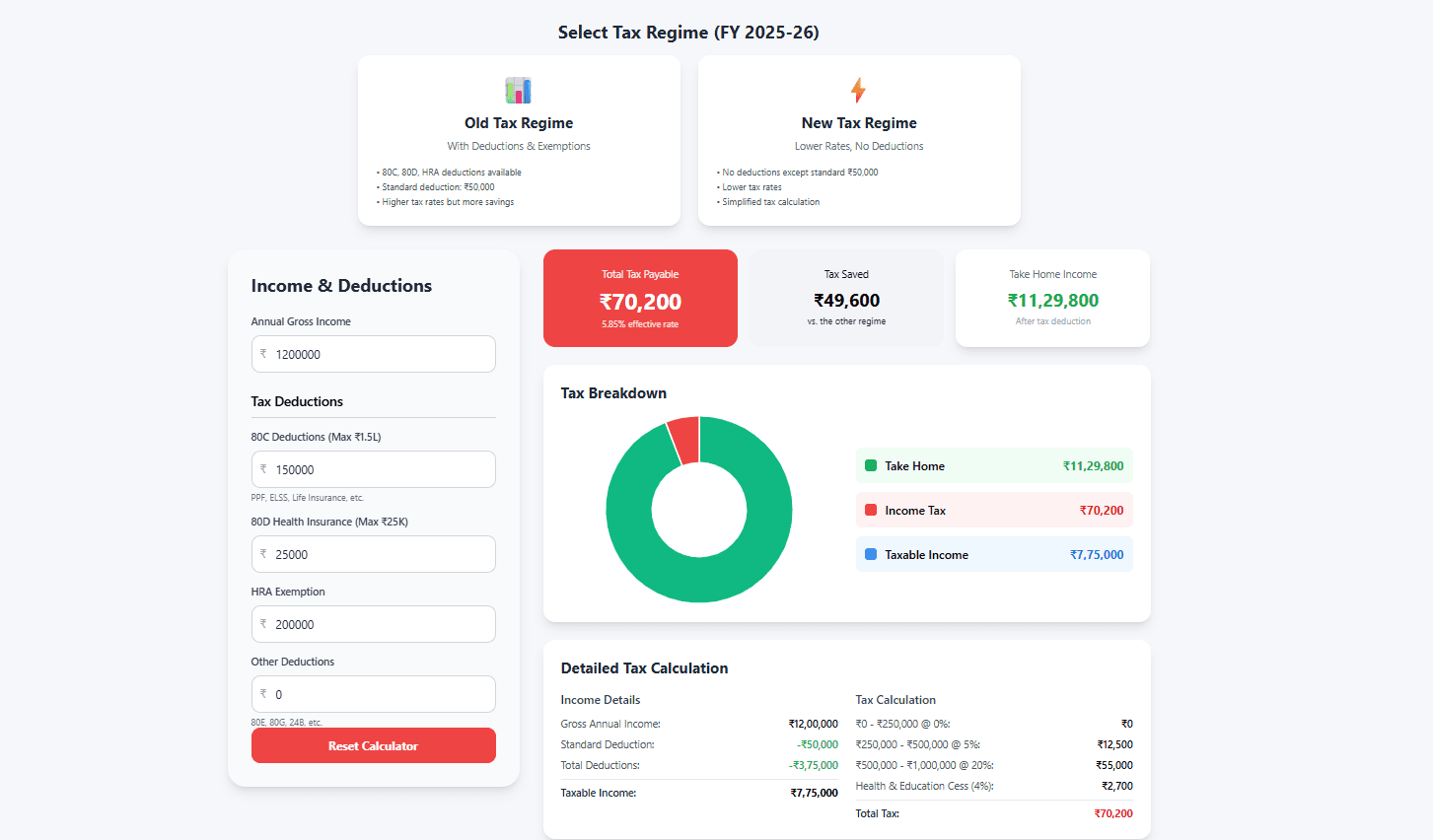
Scenario: Annual gross ₹12,00,000
Our calculator (old regime with deductions):
- Standard deduction: ₹50,000
- Section 80C (PF + investments): ₹1,50,000
- Taxable income: ₹10,00,000
- Tax calculation: ₹12,500 + 20% of (₹10,00,000 - ₹5,00,000) = ₹12,500 + ₹1,00,000 = ₹1,12,500
- Add cess (4%): ₹4,500
- Total tax: ₹1,17,000 annually
- Effective tax rate: 9.75%
PF Calculator for Retirement Planning
Your Provident Fund is not just a deduction. It is your retirement savings.
Scenario: Monthly basic salary ₹30,000
Our calculator shows:
- Employee PF contribution (12%): ₹3,600 per month
- Employer PF contribution (12%): ₹3,600 per month
- Total monthly PF contribution: ₹7,200
- Annual PF contribution: ₹86,400
- After 30 years with 8% interest: Approximately ₹1.2 crore
Now that deduction feels different, right? It is forced savings for your future.
Salary Converter for Freelancers
Freelancers often get paid hourly or per project. But you need to know your annual earnings.
Scenario: You charge ₹1,500 per hour. You work 25 billable hours per week.
Our calculator shows:
- Weekly gross: ₹37,500
- Monthly gross: ₹1,62,500
- Annual gross: ₹19,50,000
Now you can compare freelance income to salaried job offers accurately.
Common Salary Deductions Explained
Provident Fund (PF)
What is it? A retirement savings scheme where you and your employer each contribute 12% of your basic salary.
How it works:
- Employee contribution: 12% of basic salary (goes to your PF account)
- Employer contribution: 12% of basic salary (8.33% to pension, 3.67% to PF)
- You can withdraw at retirement or under specific conditions
Example: Basic salary ₹25,000
- Employee PF: ₹3,000 per month
- Employer PF: ₹3,000 per month (₹2,083 to pension, ₹917 to PF)
Professional Tax (PT)
What is it? A state-level tax on employment income.
How it works:
- Varies by state (₹200-₹2,500 per month maximum)
- Typically ₹200 per month for most salaried employees
- Deducted monthly from salary
States with professional tax: Maharashtra, Karnataka, West Bengal, Andhra Pradesh, Telangana, Gujarat, Tamil Nadu, Madhya Pradesh, Assam, Kerala, Punjab, and others.
Example (Maharashtra):
- Monthly salary up to ₹10,000: No tax
- Monthly salary ₹10,001 - ₹15,000: ₹175 per month
- Monthly salary above ₹15,000: ₹200 per month
Income Tax
What is it? Central government tax on your income.
New Tax Regime (FY 2024-25):
- Up to ₹3,00,000: 0%
- ₹3,00,001 - ₹7,00,000: 5%
- ₹7,00,001 - ₹10,00,000: 10%
- ₹10,00,001 - ₹12,00,000: 15%
- ₹12,00,001 - ₹15,00,000: 20%
- Above ₹15,00,000: 30%
- Rebate under Section 87A: Up to ₹7,00,000 (tax payable is nil)
Old Tax Regime (with deductions):
- Up to ₹2,50,000: 0%
- ₹2,50,001 - ₹5,00,000: 5%
- ₹5,00,001 - ₹10,00,000: 20%
- Above ₹10,00,000: 30%
- Standard deduction: ₹50,000
- Section 80C deduction: Up to ₹1,50,000
Social Security (Other Countries)
USA (FICA):
- Social Security: 6.2% of gross
- Medicare: 1.45% of gross
- Total employee: 7.65%
- Employer matches another 7.65%
UK (National Insurance):
- 12% on earnings between £242-£967 per week
- 2% on earnings above £967 per week
How to Calculate Salary – The Formula
Here are the mathematical formulas that salary calculators use to convert your gross pay to net take-home salary.
Step 1: Calculate Annual Gross Salary
Convert your salary to an annual figure based on your pay frequency:
| Pay Frequency | Formula |
|---|---|
| Hourly | Annual Gross = Hourly Rate × Hours Per Week × Weeks Per Year |
| Weekly | Annual Gross = Weekly Rate × Weeks Per Year |
| Bi-Weekly | Annual Gross = Bi-Weekly Rate × 26 |
| Monthly | Annual Gross = Monthly Rate × 12 |
| Annual | Annual Gross = Annual Rate (no conversion needed) |
Example: If you earn ₹50,000 per month → Annual Gross = ₹50,000 × 12 = ₹6,00,000
Step 2: Calculate Each Deduction Annually
For every deduction (tax, PF, professional tax, etc.), use one of these two formulas:
For percentage-based deductions (like income tax or PF):
Annual Deduction = Annual Gross × (Deduction Percentage ÷ 100)
Example: PF at 12% of ₹6,00,000 = ₹6,00,000 × 0.12 = ₹72,000 per year
For fixed-amount deductions (like professional tax):
Annual Deduction = Monthly Fixed Amount × 12
Example: Professional tax ₹200 per month = ₹200 × 12 = ₹2,400 per year
Step 3: Calculate Total Annual Deductions
Total Deductions = Income Tax + Provident Fund + Professional Tax + All Other Deductions
Step 4: Calculate Net Annual Salary
Net Annual Salary = Gross Annual Salary – Total Annual Deductions
Step 5: Convert Net Salary to Other Frequencies
Once you have your net annual salary, use these formulas to find your take-home pay for any period:
| Pay Frequency | Formula |
|---|---|
| Monthly Net | Net Annual ÷ 12 |
| Weekly Net | Net Annual ÷ Weeks Per Year |
| Hourly Net | Net Annual ÷ (Hours Per Week × Weeks Per Year) |
Example: Net Annual ₹5,46,000 → Monthly Net = ₹5,46,000 ÷ 12 = ₹45,500
Step 6: Calculate Effective Tax Rate
This tells you what percentage of your gross salary goes to all deductions combined:
Effective Tax Rate = (Total Deductions ÷ Gross Annual Salary) × 100
Example: ₹54,000 ÷ ₹6,00,000 × 100 = 9%
You do not need to remember any of these formulas. Our salary calculator handles all the math automatically.
Gross Salary vs Net Salary – What's the Difference?
This is the most important concept in salary calculation.
Gross Salary: The total amount your employer pays you before any deductions.
- Appears in your offer letter
- Used for loan eligibility calculations
- Used for tax filing
Net Salary (Take-Home Pay): The amount that actually reaches your bank account.
- Used for monthly budgeting
- Used for rent agreements (landlords want to see net salary)
- Used for EMI calculations
Real-world example:
A job offer shows ₹8,00,000 annual CTC (Cost to Company).
Breaking it down:
- Basic salary: ₹4,00,000
- HRA: ₹2,00,000
- Other allowances: ₹1,00,000
- Employer PF: ₹1,00,000
Your gross salary: ₹7,00,000 (excluding employer PF) Your net salary (after all deductions): Approximately ₹5,80,000 Monthly take-home: Approximately ₹48,300
That is significantly different from ₹66,666 per month (₹8,00,000 ÷ 12).
Common Questions About Salary Calculation
Q: How do I calculate my monthly take-home salary?
A: Start with your monthly gross salary. Subtract monthly deductions like income tax, provident fund, and professional tax. The remaining amount is your take-home pay. Our salary calculator does this instantly.
Q: What is the difference between CTC and gross salary?
A: CTC (Cost to Company) includes everything the employer spends on you, including employer PF contributions, bonuses, insurance premiums, and other benefits. Gross salary is what you actually receive before your own deductions. Gross salary is always lower than CTC.
Q: How is PF calculated on salary?
A: PF is calculated as 12% of your basic salary plus dearness allowance. If your basic salary is ₹25,000, your PF contribution is ₹3,000 per month.
Q: What is professional tax and who pays it?
A: Professional tax is a state-level tax on employment income. It is deducted by your employer from your monthly salary. The amount varies by state, typically ₹200-₹250 per month for most salaried employees.
Q: How do I calculate income tax on my salary?
A: First, determine your annual gross salary. Subtract standard deduction (₹50,000 in old regime) and any Section 80C deductions (up to ₹1,50,000). Then apply the tax slabs for your chosen regime (old or new). Add 4% cess to the calculated tax amount. Our calculator handles both regimes automatically.
Q: Should I choose the old tax regime or new tax regime?
A: The new regime has lower tax rates but fewer deductions. The old regime has higher rates but allows deductions like 80C, 80D, and HRA. Generally, if you have significant investments (₹1,50,000+ in 80C) and a home loan, the old regime may be better. Use our calculator to compare both.
Q: How do I convert hourly wage to annual salary?
A: Multiply your hourly rate by hours worked per week, then multiply by weeks worked per year. Example: $25 per hour × 40 hours × 52 weeks = $52,000 annual.
Q: How do I convert annual salary to hourly rate?
A: Divide your annual salary by weeks worked per year, then divide by hours per week. Example: $60,000 ÷ 52 weeks ÷ 40 hours = $28.85 per hour.
Q: What is effective tax rate?
A: Your effective tax rate is the percentage of your gross salary that goes to all taxes and deductions combined. It is always lower than your marginal tax rate. For example, if you are in the 20% tax bracket but have deductions, your effective rate might be 12-15%.
Q: Can this calculator handle salary for any country?
A: Our calculator supports multiple currencies and common deduction types. For country-specific tax rules, you may need to adjust the deduction rates manually or use a country-specific tool.
Practical Uses of Salary Calculator in Daily Life
For Job Seekers
- Compare job offers with different salary structures
- Understand your actual take-home pay before accepting an offer
- Negotiate better by knowing where deductions go
- Evaluate freelance rates against salaried positions
- Plan your budget before your first paycheck
For Employees
- Verify that your employer is deducting correct amounts
- Plan monthly expenses based on accurate take-home pay
- Calculate tax liability and plan advance tax payments
- Understand your payslip deductions
- Set savings goals based on net income
For HR and Payroll Professionals
- Generate salary breakdowns for employees
- Explain deduction components to staff
- Calculate cost-to-company for new hires
- Prepare offer letters with accurate net salary estimates
- Run what-if scenarios for salary changes
For Financial Planners
- Help clients understand their cash flow
- Plan investment strategies based on net income
- Calculate loan eligibility
- Project retirement corpus based on PF contributions
- Create accurate household budgets
Salary Calculator for Salary Negotiation
Knowing your net salary is powerful during salary negotiation.
Scenario: You receive an offer of ₹9,00,000 annual CTC.
Current job: ₹8,00,000 CTC with take-home of ₹52,000 per month.
New job after calculator: Net take-home approximately ₹55,000 per month.
Increase: Only ₹3,000 per month (₹36,000 annually), not ₹1,00,000 as the CTC suggests.
Now you can negotiate: Ask for a higher CTC to achieve your desired take-home increase.
Pro tip: Always ask recruiters for the gross salary (not just CTC) and the monthly in-hand amount. Our calculator helps you verify their numbers.
How to Use Salary Calculator for Tax Planning
Use our calculator throughout the year to optimize your taxes.
Step 1: Calculate estimated annual income Include salary, bonuses, freelance income, and other earnings.
Step 2: Estimate deductions
- Section 80C: PF, PPF, ELSS, life insurance, tuition fees (up to ₹1,50,000)
- Section 80D: Health insurance premiums (up to ₹25,000 for self, ₹50,000 for senior citizens)
- HRA: Actual rent paid minus 10% of salary
- Standard deduction: ₹50,000
Step 3: Compare regimes Run calculations for both old and new tax regimes. Choose the one with lower tax liability.
Step 4: Plan advance tax payments If your tax liability is over ₹10,000, you need to pay advance tax in installments.
Step 5: Adjust investments before March 31 If you are short on 80C deductions, invest before the financial year ends.
My Final Advice
After helping thousands of people understand their salary deductions and take-home pay, here is what I have learned:
Always calculate your net salary before accepting a job offer. The gross number is exciting, but your budget runs on the net number. A ₹1,00,000 difference in gross might only be ₹5,000 per month in hand.
Understand every deduction on your payslip. If you see something you do not recognize, ask your HR or payroll department. Small errors can add up over time.
Use PF as a savings tool, not just a deduction. That 12% going to PF is building your retirement corpus. Do not withdraw it unless absolutely necessary.
Compare tax regimes every year. What worked last year might not work this year. Our calculator helps you decide.
Check your payslip against the calculator periodically. Mistakes happen. Employers sometimes deduct the wrong amounts. Verification protects you.
And finally, remember that salary is just one part of financial wellness. What you do with your take-home pay matters more than the number itself. Budget wisely. Save consistently. Invest early.
Calculate Your Take-Home Salary Now – Free Tool
Have questions about salary calculation for a specific situation or country? Leave a comment below. I read every one.
Tags: salary calculator, take home pay calculator, net salary calculator, gross to net salary, income tax calculator, provident fund calculator, professional tax calculator, salary breakdown, salary converter, hourly to annual salary, monthly salary calculator, annual salary to hourly, salary after tax calculator, in hand salary calculator, ctc to take home calculator, effective tax rate calculator, statutory deductions calculator, payroll calculator, salary comparison tool, salary frequency converter