Grade Calculator – Complete Guide to Calculate Percentage, Letter Grades & GPA
Have you ever finished an exam and tried to calculate what percentage you need on the final to pass the class? Or maybe you have multiple assignments with different weights and you are not sure how to calculate your overall grade?
I remember my final semester of college. I had five classes, each with multiple assignments, midterms, and a final exam. All had different weights. I tried to calculate my standing in each class using a spreadsheet. It took me hours, and I still was not sure if I was correct. I kept making mistakes with the weighting.
Then a friend showed me a grade calculator. I entered all my scores and weights. Within seconds, I knew exactly where I stood in every class. That tool helped me focus my study time on the classes where I needed the most improvement.
This guide will teach you everything you need to know about calculating grades. Whether you are a student, teacher, or parent, you will learn how to compute percentages, letter grades, and GPA.
Quick access: Use our free grade calculator here
What is a Grade Calculator? Simple Answer
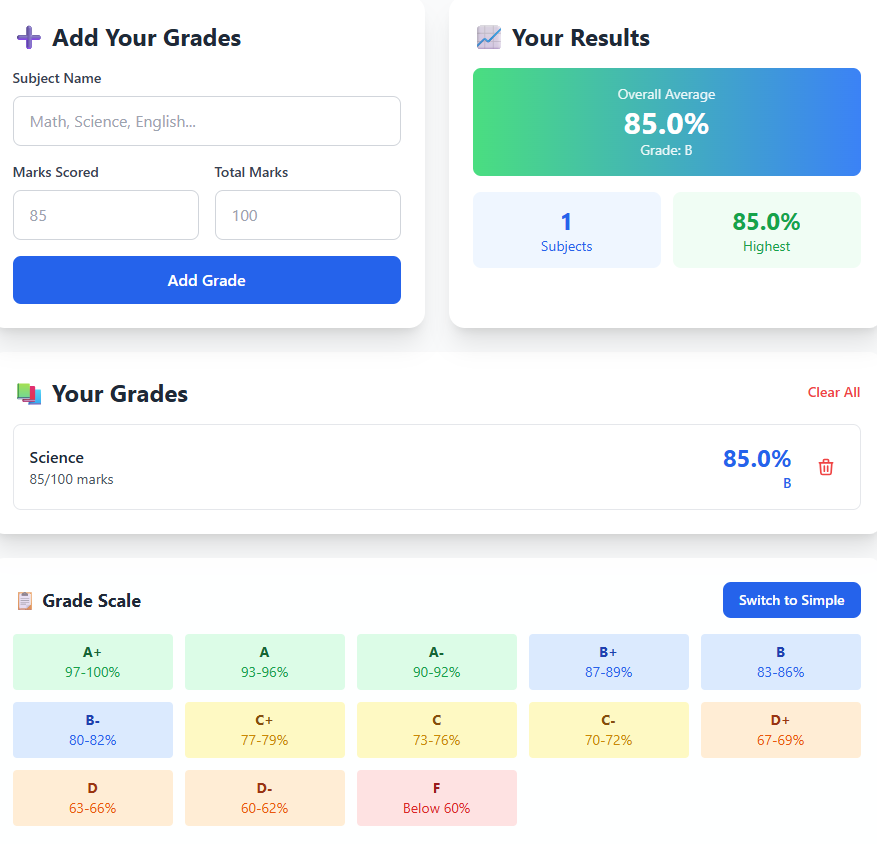
A grade calculator is a tool that helps you determine your academic performance. You enter your scores (marks) and the total possible points, and the calculator shows your percentage and letter grade.
Simple example:
- You scored 85 out of 100 on a test
- Percentage = (85 ÷ 100) × 100 = 85%
- Letter grade = B (on a standard scale)
Grade calculators become especially useful when you have multiple assignments, tests, or subjects with different weights.
Why Use a Grade Calculator?
For students:
- Know exactly where you stand in each class
- Calculate what you need on the final exam to pass
- Track your progress throughout the semester
- Identify weak subjects that need more attention
- Reduce anxiety about grades
For teachers:
- Quickly calculate student grades
- Standardize grading across assignments
- Generate grade reports
- Save time on manual calculations
For parents:
- Understand your child's academic standing
- Track progress across subjects
- Identify areas needing improvement
How to Calculate Percentage – The Basic Formula
Calculating percentage is the foundation of grade calculation. The formula is simple.
Basic Percentage Formula
Percentage = (Marks Obtained ÷ Total Marks) × 100
Example 1: Single assignment
- Marks obtained: 45
- Total marks: 50
- Percentage = (45 ÷ 50) × 100 = 90%
Example 2: Test with different total marks
- Marks obtained: 78
- Total marks: 100
- Percentage = (78 ÷ 100) × 100 = 78%
Example 3: Assignment with partial credit
- Marks obtained: 32
- Total marks: 40
- Percentage = (32 ÷ 40) × 100 = 80%
Multiple Assignments – Calculating Average Percentage
When you have multiple assignments or tests, you need the average percentage.
Formula: Average Percentage = (Sum of all percentages) ÷ (Number of items)
Example:
- Assignment 1: 90%
- Assignment 2: 85%
- Assignment 3: 78%
- Assignment 4: 92%
Average = (90 + 85 + 78 + 92) ÷ 4 = 345 ÷ 4 = 86.25%
Weighted Grades – When Assignments Have Different Importance
Some assignments are worth more than others. A final exam might be 40% of your grade, while homework might be only 10%.
Weighted grade formula:
Weighted Grade = Σ (Score × Weight) ÷ Σ (Weights)
Example:
- Homework (10% weight): Score 95%
- Midterm (30% weight): Score 82%
- Final exam (40% weight): Score 78%
- Project (20% weight): Score 88%
Step 1: Multiply each score by its weight
- Homework: 95 × 0.10 = 9.5
- Midterm: 82 × 0.30 = 24.6
- Final exam: 78 × 0.40 = 31.2
- Project: 88 × 0.20 = 17.6
Step 2: Add the weighted scores: 9.5 + 24.6 + 31.2 + 17.6 = 82.9
Final grade: 82.9% (B grade)
Grading Scales – Converting Percentages to Letter Grades
Different schools and countries use different grading scales. Here are the most common ones.
Simple Grading Scale (A-F)
This scale is widely used in many schools, especially in the United States.
| Percentage Range | Letter Grade | Description |
|---|---|---|
| 90% - 100% | A | Excellent |
| 80% - 89% | B | Good |
| 70% - 79% | C | Average |
| 60% - 69% | D | Below Average |
| Below 60% | F | Fail |
Detailed Grading Scale (with plus/minus)
This scale provides more granular feedback.
| Percentage Range | Letter Grade | Description |
|---|---|---|
| 97% - 100% | A+ | Outstanding |
| 93% - 96% | A | Excellent |
| 90% - 92% | A- | Very Good |
| 87% - 89% | B+ | Good Plus |
| 83% - 86% | B | Good |
| 80% - 82% | B- | Fairly Good |
| 77% - 79% | C+ | Satisfactory Plus |
| 73% - 76% | C | Satisfactory |
| 70% - 72% | C- | Below Satisfactory |
| 67% - 69% | D+ | Weak Plus |
| 63% - 66% | D | Weak |
| 60% - 62% | D- | Very Weak |
| Below 60% | F | Fail |
International Grading Scales
Indian Grading System (Percentage based):
| Percentage | Grade | Description |
|---|---|---|
| 90% - 100% | A1 | Outstanding |
| 80% - 89% | A2 | Excellent |
| 70% - 79% | B1 | Very Good |
| 60% - 69% | B2 | Good |
| 50% - 59% | C1 | Average |
| 40% - 49% | C2 | Below Average |
| Below 40% | D | Fail |
UK Grading System (Honors classification):
| Percentage | Classification |
|---|---|
| 70% - 100% | First Class Honours (1st) |
| 60% - 69% | Upper Second Class Honours (2:1) |
| 50% - 59% | Lower Second Class Honours (2:2) |
| 40% - 49% | Third Class Honours (3rd) |
| Below 40% | Fail |
GPA (Grade Point Average) – Understanding and Calculating
GPA is a standardized way to measure academic achievement, typically on a 4.0 scale.
Standard GPA Conversion Table
| Letter Grade | GPA Value | Percentage Equivalent (typical) |
|---|---|---|
| A+ | 4.0 | 97% - 100% |
| A | 4.0 | 93% - 96% |
| A- | 3.7 | 90% - 92% |
| B+ | 3.3 | 87% - 89% |
| B | 3.0 | 83% - 86% |
| B- | 2.7 | 80% - 82% |
| C+ | 2.3 | 77% - 79% |
| C | 2.0 | 73% - 76% |
| C- | 1.7 | 70% - 72% |
| D+ | 1.3 | 67% - 69% |
| D | 1.0 | 63% - 66% |
| D- | 0.7 | 60% - 62% |
| F | 0.0 | Below 60% |
How to Calculate GPA
Formula: GPA = (Sum of (Grade Points × Credit Hours)) ÷ (Sum of Credit Hours)
Example with credit hours:
- Math (3 credits): Grade B = 3.0 points → 3 × 3.0 = 9.0
- English (3 credits): Grade A = 4.0 points → 3 × 4.0 = 12.0
- Science (4 credits): Grade B+ = 3.3 points → 4 × 3.3 = 13.2
- History (2 credits): Grade A- = 3.7 points → 2 × 3.7 = 7.4
Step 1: Sum of (Grade Points × Credits) = 9.0 + 12.0 + 13.2 + 7.4 = 41.6
Step 2: Sum of Credits = 3 + 3 + 4 + 2 = 12
Step 3: GPA = 41.6 ÷ 12 = 3.47
Weighted GPA vs Unweighted GPA
Unweighted GPA (4.0 scale):
- All classes are treated equally
- Maximum is 4.0
- Standard for most colleges
Weighted GPA (5.0+ scale):
- Honors, AP, or IB classes get extra points
- AP class A might be worth 5.0 instead of 4.0
- Maximum can be 5.0 or higher
How to Calculate What You Need on a Final Exam
One of the most useful features of a grade calculator is figuring out what score you need on the final exam to achieve your target grade.
Final Exam Needed Score Formula
Needed Score = (Target Grade - Current Grade × (1 - Final Weight)) ÷ Final Weight
Example:
- Current grade before final: 78%
- Target grade: 80% (B-)
- Final exam weight: 30% (0.30)
Step 1: Current contribution = 78 × (1 - 0.30) = 78 × 0.70 = 54.6
Step 2: Needed = (80 - 54.6) ÷ 0.30 = 25.4 ÷ 0.30 = 84.7%
Answer: You need to score 85% on the final exam to get an 80% overall.
Final Exam Calculator Table
| Current Grade | Target Grade | Final Weight | Needed on Final |
|---|---|---|---|
| 75% | 80% | 20% | 100% |
| 75% | 80% | 30% | 92% |
| 75% | 80% | 40% | 88% |
| 80% | 85% | 20% | 105% (impossible) |
| 80% | 85% | 30% | 97% |
| 80% | 85% | 40% | 93% |
Note: If the needed score is above 100%, it is impossible to reach your target grade.
How to Use Our Grade Calculator
Our grade calculator simplifies all these calculations.
Step 1: Select your grading scale (Simple or Detailed)
Step 2: Add subjects or assignments one by one
- Enter the subject/assignment name
- Enter your scored marks
- Enter the total possible marks
Step 3: View your results instantly:
- Percentage for each subject
- Letter grade for each subject
- Overall average percentage
- Highest score across subjects
Step 4: Add or remove subjects as needed
Step 5: Save your grades (stored locally in your browser)
All calculations are automatic. No manual formulas needed.
Real-Life Examples of Grade Calculation
Example 1: High School Student with 6 Subjects
Student: 10th grade student with 6 subjects
Scores:
- Math: 85/100
- Science: 78/100
- English: 92/100
- Social Studies: 81/100
- Second Language: 88/100
- Computer Science: 95/100
Step 1: Calculate each percentage
- Math: 85%
- Science: 78%
- English: 92%
- Social Studies: 81%
- Second Language: 88%
- Computer Science: 95%
Step 2: Sum percentages = 85 + 78 + 92 + 81 + 88 + 95 = 519
Step 3: Average = 519 ÷ 6 = 86.5%
Step 4: Letter grade (simple scale) = B
Result: Overall percentage 86.5%, B grade.
Example 2: College Student with Weighted Grades
Student: College student with different weights for each component
Course: Introduction to Psychology
- Homework (15% weight): 88%
- Quizzes (15% weight): 76%
- Midterm (30% weight): 82%
- Final exam (40% weight): Need to calculate
Current grade before final:
- Homework: 88 × 0.15 = 13.2
- Quizzes: 76 × 0.15 = 11.4
- Midterm: 82 × 0.30 = 24.6
- Total = 13.2 + 11.4 + 24.6 = 49.2 out of 60 possible (without final)
Current percentage = 49.2 ÷ 60 × 100 = 82%
To get a B (80% overall):
- Current contribution: 82 × 0.60 = 49.2
- Needed on final = (80 - 49.2) ÷ 0.40 = 30.8 ÷ 0.40 = 77%
To get a B+ (87% overall):
- Needed on final = (87 - 49.2) ÷ 0.40 = 37.8 ÷ 0.40 = 94.5%
Example 3: Teacher Calculating Class Grades
Teacher: Grading 30 students in a class
Assignment structure:
- Assignment 1 (100 points)
- Assignment 2 (100 points)
- Midterm (200 points)
- Final exam (200 points)
- Total points possible: 600
Student A's scores:
- Assignment 1: 85
- Assignment 2: 92
- Midterm: 165
- Final exam: 178
Total points: 85 + 92 + 165 + 178 = 520
Percentage: 520 ÷ 600 × 100 = 86.7%
Letter grade: B
Common Grade Calculation Mistakes to Avoid
Mistake 1: Forgetting to Convert Weights to Decimals
Problem: Using 30 instead of 0.30 for 30% weight
Solution: Always divide percentages by 100. 30% = 30 ÷ 100 = 0.30
Mistake 2: Averaging Percentages Without Considering Weights
Problem: Adding 90% and 80% and dividing by 2, when one was worth 75% of the grade
Solution: Use weighted average formula. Multiply each score by its weight.
Mistake 3: Using the Wrong Grading Scale
Problem: Using simple scale when your school uses detailed (with plus/minus)
Solution: Check your school's grading policy before interpreting letter grades.
Mistake 4: Misunderstanding Total Points
Problem: Adding points from different assignments when totals are different
Solution: Convert to percentages first, then average, or use total points method.
Mistake 5: Not Accounting for Extra Credit
Problem: Extra credit points can change the total possible points
Solution: Add extra credit to the scored marks without changing total possible marks.
Grading Terms Explained
| Term | Definition |
|---|---|
| Percentage | Score expressed out of 100. Formula: (Marks ÷ Total) × 100 |
| Letter Grade | Alphabetic representation (A, B, C, D, F) of performance |
| GPA | Grade Point Average on a 4.0 (or other) scale |
| Credit Hours | Weight assigned to a course based on time/importance |
| Weighted Grade | Grade calculated by giving different importance to components |
| Curve | Adjustment of grades based on class performance distribution |
| Pass/Fail | Binary grading system without letter grades |
| Rubric | Set of criteria for grading assignments |
Frequently Asked Questions
Q: How to calculate grade percentage?
A: Use the formula: (Marks Obtained ÷ Total Marks) × 100. For example, 85 out of 100 = (85 ÷ 100) × 100 = 85%.
Q: What is a good grade calculator?
A: Our grade calculator is free, supports multiple subjects, and offers both simple and detailed grading scales.
Q: How to calculate average grade for multiple subjects?
A: Add all subject percentages and divide by the number of subjects. Our calculator does this automatically.
Q: What is the difference between simple and detailed grading scales?
A: Simple scale uses A, B, C, D, F. Detailed scale adds plus/minus (A+, A-, B+, B-, etc.) for more precise grading.
Q: How to convert percentage to letter grade?
A: Use a grading scale. For simple scale: 90-100% = A, 80-89% = B, 70-79% = C, 60-69% = D, below 60% = F.
Q: How to calculate GPA from letter grades?
A: Convert each letter grade to grade points (A=4.0, B=3.0, C=2.0, D=1.0, F=0.0), multiply by credit hours, sum, and divide by total credit hours.
Q: What score do I need on my final exam to pass?
A: Use the formula: (Target Grade - Current Grade × (1 - Final Weight)) ÷ Final Weight. Our calculator can help with this.
Q: Can I calculate weighted grades with this tool?
A: Yes. Enter each assignment with its points. Our calculator automatically handles weighting based on total points.
Q: Does the grade calculator save my data?
A: Yes. Grades are saved locally in your browser. You can close and reopen the page without losing your data.
Q: Is the grade calculator free?
A: Yes. Completely free. No signup required. No limits.
Q: Can teachers use this for grading multiple students?
A: Yes. Teachers can enter scores for each student and calculate percentages and letter grades instantly.
Q: What is a passing grade?
A: Typically 60% or D is the minimum passing grade. Some schools require 70% or C. Check your school's policy.
Q: How to calculate grade with different total marks?
A: Convert each to percentage first, then average. Or use total points: sum of marks obtained ÷ sum of total marks × 100.
Q: What is the highest possible GPA?
A: Unweighted GPA maximum is 4.0. Weighted GPA (with AP/IB classes) can be 5.0 or higher.
Q: Does the calculator work on mobile?
A: Yes. The tool is fully responsive and works on phones, tablets, and computers.
My Final Advice
After years of calculating grades as a student and helping others, here is what I have learned.
Track your grades throughout the semester. Do not wait until finals to calculate where you stand. Regular tracking helps you identify weak subjects early.
Understand your grading scale. Every school is different. Know whether they use simple A-F, plus/minus, or percentage-based grading.
Use weighted calculations for accurate results. If assignments have different importance, use weighted averages. Simple averages will be wrong.
Calculate what you need on finals. Knowing the score needed on your final exam reduces anxiety and helps you focus your studying.
Keep a record of your grades. Save your grade calculations. They help with scholarship applications, college admissions, and tracking improvement over time.
And finally, use a good grade calculator. Our tool handles percentages, letter grades, multiple subjects, and different grading scales. It is free and works on any device.
Calculate Your Grades Now – Free Tool
Have questions about grade calculation for a specific situation? Leave a comment below. I try to answer every one.
Tags: grade calculator, how to calculate grades, gpa calculator, percentage calculator, letter grade calculator, grading scale, simple grading scale, detailed grading scale, calculate average grade, calculate semester grade, grade percentage formula, marks to percentage converter, subject wise grade calculator, grade calculator for students, grade calculator for teachers, a b c d f grading system, grade calculator online free, final grade calculator, weighted grade calculator, test grade calculator, exam grade calculator, assignment grade calculator, grade calculator with multiple subjects, grade calculator with grading scale options, highest score calculator, grade tracking tool, academic performance tracker, convert percentage to letter grade, convert letter grade to gpa, gpa conversion table, grading terms explained