How to Calculate Social Media Engagement Rate – Instagram, TikTok, YouTube & Twitter Guide
Have you ever wondered why some creators with fewer followers get better brand deals than others with huge followings? Or maybe you have been trying to grow your social media but cannot figure out if your content is actually connecting with your audience?
I remember when I first started tracking my social media performance. I had about 15,000 followers on Instagram, but brands kept rejecting my collaboration requests. I did not understand why. Then someone explained engagement rate to me. I calculated mine and found out it was only 0.8%. That is below average. I was posting regularly, but nobody was interacting.
That is when I started learning about engagement rate. After months of testing different content strategies, I finally got my engagement rate up to 4.5%. Brands started reaching out to me instead of the other way around.
This guide will show you exactly how to calculate engagement rate, what numbers to aim for, and how to improve your own rate. No complicated formulas. Just practical advice that works.
Quick access: Use our free engagement rate calculator here
What is Engagement Rate? Simple Answer
Engagement rate is the percentage of your followers who actually interact with your content. Interactions include likes, comments, shares, saves, and retweets.
Think of it this way. Having 100,000 followers means nothing if only 100 of them like your posts. That is a 0.1% engagement rate. On the other hand, having 10,000 followers with 1,000 likes and comments means a 10% engagement rate. Brands prefer the second creator because their audience actually pays attention.
Engagement rate shows quality, not just quantity.
Why Engagement Rate Matters More Than Follower Count
Here is what I learned from my own experience. Follower count is a vanity metric. Engagement rate is a real metric.
For influencers and creators:
- Brands pay more for higher engagement rates
- A smaller, engaged audience is more valuable than a large, passive one
- Engagement rate proves you have influence, not just numbers
For marketers and brands:
- You can spot fake followers or bought engagement
- Campaign success depends on real interactions, not impressions
- ROI is higher when engagement rate is strong
For platform algorithms:
- Instagram, TikTok, and YouTube promote content with high engagement
- More engagement means more reach
- More reach means more growth
I have seen accounts with 5,000 followers and 15% engagement grow faster than accounts with 100,000 followers and 1% engagement. The algorithm favors content people actually interact with.
The Simple Engagement Rate Formula
The basic formula for engagement rate is straightforward.
Engagement Rate (%) = (Total Engagements ÷ Followers) × 100
Where total engagements = likes + comments + shares + saves (depending on the platform).
Real Example
Let us say you have:
- Followers: 10,000
- Likes: 800
- Comments: 100
- Shares: 50
- Saves: 50
Step 1: Total engagements = 800 + 100 + 50 + 50 = 1,000
Step 2: 1,000 ÷ 10,000 = 0.1
Step 3: 0.1 × 100 = 10%
Your engagement rate is 10%. That is excellent on most platforms.
Different Ways to Calculate Engagement Rate
There are actually a few different methods to calculate engagement rate. Each has its own use case.
Method 1: Reach-Based Engagement Rate
Instead of dividing by followers, you divide by reach (how many people actually saw your post).
Formula: (Engagements ÷ Reach) × 100
This is useful when you want to know how engaging your post is to people who actually see it. Most social media analytics tools show reach.
Method 2: Post-by-Post Engagement Rate
Calculate engagement rate for each post, then average them over your last 10 to 20 posts.
Formula: Average of [(Engagements per post ÷ Followers) × 100] for all posts
This gives you a more accurate picture because some posts perform better than others.
Method 3: Engagement Rate by Impressions
Similar to reach-based, but using impressions (how many times your post was shown, including multiple views by the same person).
Formula: (Engagements ÷ Impressions) × 100
Brands often use this for paid campaigns to measure ad performance.
For most creators, the basic follower-based formula works fine. Our engagement rate calculator uses the standard method that brands and influencers commonly accept.
Engagement Rate Benchmarks by Platform
After analyzing hundreds of accounts across different platforms, here are the average engagement rates you should aim for.
Instagram Engagement Rate Benchmarks
| Performance | Engagement Rate |
|---|---|
| Poor | Below 1% |
| Average | 1% to 3% |
| Good | 3% to 5% |
| Excellent | Above 5% |
What this means: If you have 10,000 Instagram followers and get 300 total engagements (likes, comments, shares, saves) per post, that is a 3% engagement rate. That is considered good.
Instagram reels generally have higher engagement rates than feed posts. Carousels (multiple images) also perform better than single images.
TikTok Engagement Rate Benchmarks
| Performance | Engagement Rate |
|---|---|
| Poor | Below 4% |
| Average | 4% to 7% |
| Good | 7% to 10% |
| Excellent | Above 10% |
TikTok has higher engagement rates because the platform is built for viral content. Even a 5% engagement rate on TikTok is considered decent. Anything above 10% is outstanding.
YouTube Engagement Rate Benchmarks
| Performance | Engagement Rate |
|---|---|
| Poor | Below 0.5% |
| Average | 0.5% to 1.5% |
| Good | 1.5% to 3% |
| Excellent | Above 3% |
YouTube engagement rates are lower because watching a video requires more commitment than liking a photo. A 2% engagement rate on YouTube is actually very good.
Note: For YouTube, some creators calculate engagement based on views instead of subscribers. The formula becomes (likes + comments) ÷ views × 100. This gives higher numbers.
Twitter (X) Engagement Rate Benchmarks
| Performance | Engagement Rate |
|---|---|
| Poor | Below 0.2% |
| Average | 0.2% to 0.5% |
| Good | 0.5% to 1% |
| Excellent | Above 1% |
Twitter has the lowest engagement rates because content moves fast and users scroll quickly. A 1% engagement rate on Twitter is actually very strong.
How to Calculate Engagement Rate for Each Platform
Instagram Engagement Rate Calculation
Instagram engagements include:
- Likes
- Comments
- Shares (also called reposts)
- Saves
Do not include: Story views (they are not counted in standard engagement rate)
Example:
- Followers: 25,000
- Likes: 1,200
- Comments: 150
- Shares: 80
- Saves: 200
Total engagements = 1,200 + 150 + 80 + 200 = 1,630 Engagement rate = (1,630 ÷ 25,000) × 100 = 6.52% (Excellent)
TikTok Engagement Rate Calculation
TikTok engagements include:
- Likes
- Comments
- Shares
- Saves (bookmarks)
Example:
- Followers: 50,000
- Likes: 8,000
- Comments: 400
- Shares: 1,200
- Saves: 600
Total engagements = 8,000 + 400 + 1,200 + 600 = 10,200 Engagement rate = (10,200 ÷ 50,000) × 100 = 20.4% (Outstanding)
YouTube Engagement Rate Calculation
YouTube engagements include:
- Likes
- Comments
- Shares
Note: YouTube does not have a public "saves" metric for videos.
Example:
- Subscribers: 100,000
- Likes: 3,000
- Comments: 500
- Shares: 200
Total engagements = 3,000 + 500 + 200 = 3,700 Engagement rate = (3,700 ÷ 100,000) × 100 = 3.7% (Excellent for YouTube)
Twitter Engagement Rate Calculation
Twitter engagements include:
- Likes
- Replies (comments)
- Retweets
- Quote tweets
Example:
- Followers: 20,000
- Likes: 300
- Replies: 40
- Retweets: 60
- Quote tweets: 10
Total engagements = 300 + 40 + 60 + 10 = 410 Engagement rate = (410 ÷ 20,000) × 100 = 2.05% (Excellent for Twitter)
How to Use Our Engagement Rate Calculator
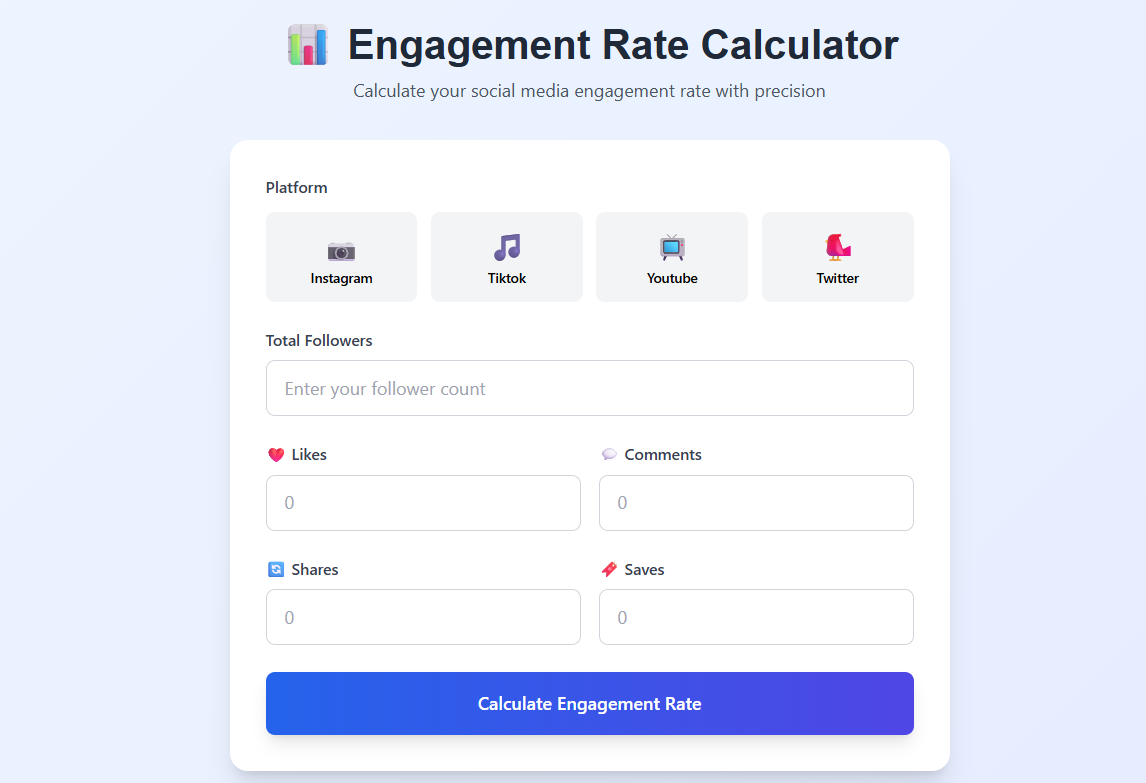
Our free engagement rate calculator makes all these calculations instant.
Step 1: Select your platform (Instagram, TikTok, YouTube, or Twitter)
Step 2: Enter your total followers or subscribers
Step 3: Enter your likes, comments, shares, and saves (where applicable)
Step 4: Click Calculate
You will see:
- Your engagement rate percentage
- Total engagements
- Performance rating (Poor, Average, Good, or Excellent)
- Breakdown of each engagement type
No math required. No spreadsheets. Just instant results.
What is a Good Engagement Rate? Realistic Expectations
Based on my experience analyzing hundreds of accounts:
For micro-influencers (1,000 to 10,000 followers):
- Good: 5% to 8%
- Excellent: Above 8%
Micro-influencers usually have higher engagement rates because their audiences are more personal and connected.
For mid-tier influencers (10,000 to 100,000 followers):
- Good: 3% to 5%
- Excellent: Above 5%
As your follower count grows, engagement rate naturally drops. This is normal.
For macro-influencers (100,000+ followers):
- Good: 1.5% to 3%
- Excellent: Above 3%
Large accounts struggle to maintain high engagement because their audience is more diverse and less personal.
For brands and businesses:
- Good: 1% to 2%
- Excellent: Above 2%
Brand accounts typically have lower engagement because followers do not feel as personally connected.
How to Calculate Instagram Engagement Manually (Step by Step)
If you want to calculate without a tool, here is how I do it.
Step 1: Pick your last 10 to 15 posts
Step 2: For each post, note:
- Number of likes
- Number of comments
- Number of shares
- Number of saves
Step 3: Add up all engagements across all posts
Step 4: Divide by number of posts to get average engagements per post
Step 5: Divide by your follower count
Step 6: Multiply by 100
Example with 3 posts:
- Post 1: 500 likes, 50 comments, 20 shares, 30 saves = 600 engagements
- Post 2: 400 likes, 30 comments, 10 shares, 20 saves = 460 engagements
- Post 3: 600 likes, 60 comments, 25 shares, 40 saves = 725 engagements
Total engagements = 600 + 460 + 725 = 1,785 Average per post = 1,785 ÷ 3 = 595 Follower count = 12,000 Engagement rate = (595 ÷ 12,000) × 100 = 4.96% (Good)
This method gives you a more accurate picture than just one post.
How to Increase Your Engagement Rate (What Actually Works)
After struggling with low engagement myself, I tried many strategies. Here is what actually worked.
Strategy 1: Post When Your Audience Is Active
Posting at the right time doubled my engagement within two weeks.
Check your analytics to see when your followers are online. For most accounts, the best times are:
- Instagram: 7 AM to 9 AM and 5 PM to 6 PM on weekdays
- TikTok: 6 PM to 9 PM on weekdays
- YouTube: Weekends between 9 AM and 11 AM
Test different times and track what works for your specific audience.
Strategy 2: Ask Questions in Captions
This is the simplest change that made the biggest difference for me.
Instead of "Here is my new recipe," try "What is your favorite ingredient to add to this dish?"
Questions force people to comment. More comments mean higher engagement rate.
Strategy 3: Reply to Every Comment (At First)
When you reply to comments, more people comment because they know you will respond.
In my early days, I replied to every single comment for the first hour after posting. This told the algorithm that my post was getting engagement, so it showed it to more people.
Strategy 4: Use Saves and Shares Triggers
Tell people why they should save or share your post.
Examples:
- "Save this for later"
- "Share this with someone who needs to hear this"
- "Tag a friend who would love this"
These simple calls to action work.
Strategy 5: Post Interactive Content
Some content types naturally get more engagement:
- Polls and quizzes (Instagram Stories)
- "This or That" posts
- Fill-in-the-blank captions
- Controversial (but respectful) opinions
- Behind-the-scenes content
Strategy 6: Use Trending Audio on TikTok and Reels
When I started using trending audio, my reach and engagement both increased significantly.
Check the TikTok creative center or Instagram Reels trends page to see what audio is currently popular.
Strategy 7: Post Consistently, Not Randomly
Consistency trains your audience to expect your content.
I post every Tuesday and Thursday at 7 PM. My audience knows this. They look forward to it. Engagement is higher on those days.
How Brands Use Engagement Rate to Find Influencers
As someone who has worked with brands, let me tell you what they look for.
What brands want:
- Engagement rate above 3% for Instagram
- Authentic comments (not just emojis)
- Real conversations in the comment section
- Consistent engagement across posts
What brands avoid:
- Engagement rate below 1%
- Sudden spikes in engagement (could be bots)
- Comments that are all the same (like "Nice pic" repeated)
- High follower count but low engagement
If you want brand deals, focus on engagement rate, not follower count. A brand will choose a creator with 5,000 followers and 8% engagement over someone with 50,000 followers and 1.5% engagement.
Common Engagement Rate Mistakes to Avoid
Mistake 1: Including Story Views
Story views are not counted in standard engagement rate. Including them will inflate your numbers and brands will know.
Mistake 2: Calculating Based on One Post
One viral post can give you a false picture. Always average across at least 10 posts.
Mistake 3: Ignoring Saves and Shares
Many people only count likes and comments. Saves and shares show deeper engagement. Include them.
Mistake 4: Comparing Across Platforms
A 2% engagement rate on YouTube is excellent. On TikTok, it is poor. Always compare within the same platform.
Mistake 5: Buying Engagement
Bought likes and comments are easy to spot. Brands use tools to detect fake engagement. It will hurt your reputation.
Frequently Asked Questions
Q: How to calculate engagement rate on Instagram?
A: Use the formula (likes + comments + shares + saves) ÷ followers × 100. For example, 1,000 engagements ÷ 10,000 followers × 100 = 10% engagement rate.
Q: What is a good engagement rate on Instagram?
A: 1% to 3% is average. 3% to 5% is good. Above 5% is excellent.
Q: How to calculate engagement rate on TikTok?
A: Same formula as Instagram. Add likes, comments, shares, and saves. Divide by followers. Multiply by 100.
Q: What is a good engagement rate on TikTok?
A: 4% to 7% is average. 7% to 10% is good. Above 10% is excellent.
Q: How to calculate YouTube engagement rate?
A: (likes + comments + shares) ÷ subscribers × 100. Some creators use views instead of subscribers.
Q: What is a good engagement rate on YouTube?
A: 0.5% to 1.5% is average. 1.5% to 3% is good. Above 3% is excellent.
Q: How to calculate Twitter engagement rate?
A: (likes + replies + retweets + quote tweets) ÷ followers × 100.
Q: What is a good engagement rate on Twitter?
A: 0.2% to 0.5% is average. 0.5% to 1% is good. Above 1% is excellent.
Q: Why is my engagement rate dropping?
A: Possible reasons: inconsistent posting, lower content quality, algorithm changes, or audience fatigue. Check your analytics to find the cause.
Q: Can I calculate engagement rate for free?
A: Yes. Use our free engagement rate calculator. No signup required.
Q: Do brands care about engagement rate?
A: Yes. Most brands care more about engagement rate than follower count. It shows real influence.
Q: How often should I calculate my engagement rate?
A: Once a week or once a month. Track trends over time rather than focusing on one day.
Q: Does engagement rate affect the algorithm?
A: Yes. Platforms show your content to more people when engagement rate is high.
Q: What is the fastest way to increase engagement rate?
A: Ask questions in captions, reply to comments, and post when your audience is active.
Q: Should I include video views in engagement rate?
A: No. Standard engagement rate only includes active interactions (likes, comments, shares, saves).
My Final Advice
After years of tracking engagement rates across multiple platforms, here is what I have learned.
Do not obsess over daily numbers. Engagement rate fluctuates. Focus on trends over weeks and months.
Quality over quantity. One great post per week that gets 10% engagement is better than seven average posts that get 1% each.
Engage back. The best way to get engagement is to give it. Comment on other creators' posts. Reply to your comments. Be part of the community.
Be patient. Improving engagement rate takes time. My rate went from 0.8% to 4.5% over eight months. It did not happen overnight.
And finally, use a good engagement rate calculator. It saves time and gives you accurate numbers you can trust.
Calculate Your Engagement Rate Now – Free Tool
Have questions about your specific engagement rate? Leave a comment below. I read every one.
Tags: engagement rate calculator, how to calculate engagement rate, instagram engagement calculator, tiktok engagement calculator, youtube engagement rate tool, twitter engagement calculator, influencer marketing tool, social media engagement formula, engagement rate formula, what is a good engagement rate, how to increase engagement rate, instagram engagement rate benchmark, tiktok engagement rate average, youtube engagement rate calculator, engagement rate for influencers, social media metrics calculator, post engagement rate, follower engagement rate, engagement rate per post, average engagement rate by platform, how to calculate instagram engagement manually, engagement rate formula explained, social media performance tracker, brand collaboration engagement rate, instagram reel engagement calculator, tiktok engagement rate formula, youtube likes and comments engagement