What is UTC Time – Complete Guide to Coordinated Universal Time
Have you ever booked an international flight and seen departure times listed as "UTC" or "Zulu time" and wondered what that meant? Or maybe you are a developer working with timestamps from different servers and noticed they all use the same time reference?
I remember my first international video call with a client in Japan. I am in New York. We agreed on 10 AM. But 10 AM where? My 10 AM or their 10 AM? I showed up at my 10 AM, but it was 11 PM in Japan. Nobody was on the call. That embarrassing mistake taught me the importance of having a global time standard.
After that experience, I learned about UTC. Now I use it for all international scheduling. This guide will explain UTC in simple terms. No complicated jargon. Just clear explanations and real examples you can use.
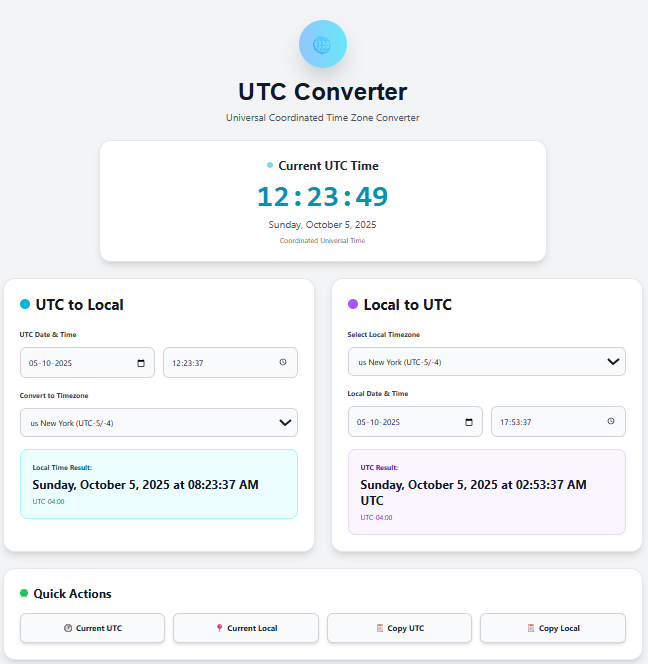
Quick access: Use our free UTC converter here
What is UTC? Simple Answer
UTC stands for Coordinated Universal Time. It is the world's time standard. Think of it like a master clock that every other clock in the world refers to.
All time zones around the world are defined by how many hours they are ahead of or behind UTC.
Examples:
- New York is UTC -5 (5 hours behind UTC)
- London is UTC +0 (same as UTC)
- India is UTC +5:30 (5 hours 30 minutes ahead of UTC)
- Tokyo is UTC +9 (9 hours ahead of UTC)
- Sydney is UTC +11 (11 hours ahead of UTC)
When it is 12:00 UTC (noon), the time in different cities is:
- New York: 7:00 AM (12 - 5)
- London: 12:00 PM (same as UTC)
- India: 5:30 PM (12 + 5:30)
- Tokyo: 9:00 PM (12 + 9)
Why is this useful? Instead of learning every country's time zone, you just need to know their UTC offset. If you know your UTC offset and their UTC offset, you can calculate the time difference in seconds.
UTC vs GMT – What is the Difference?
Many people use UTC and GMT interchangeably, but they are not exactly the same. Here is the difference.
GMT (Greenwich Mean Time)
GMT is based on the Earth's rotation. It was the original time standard. The Earth takes 24 hours to rotate, but this rotation is not perfectly consistent. It slows down and speeds up slightly over time.
Pros of GMT:
- Simple to understand
- Based on natural phenomenon (Earth's rotation)
Cons of GMT:
- Not perfectly precise (Earth's rotation varies)
- Can drift over long periods
UTC (Coordinated Universal Time)
UTC is based on atomic clocks. Atomic clocks measure vibrations of atoms and are incredibly precise. They lose about 1 second every 100 million years.
Pros of UTC:
- Extremely precise (atomic clock based)
- Does not drift
- The modern international standard
Cons of UTC:
- Requires leap seconds to stay aligned with Earth's rotation
The Simple Difference
| Aspect | GMT | UTC |
|---|---|---|
| Based on | Earth's rotation | Atomic clocks |
| Precision | Variable | Extremely precise |
| Used as | Time zone (UK) | Global time standard |
| Leap seconds | No | Yes |
In everyday use: For most practical purposes, UTC and GMT are the same. London time (GMT) is usually the same as UTC, except during daylight saving time when London switches to UTC+1.
A Brief History of UTC
Understanding how UTC came to be helps explain why we have it today.
Before UTC: Local Sun Time
Before trains and telephones, every town had its own local time based on the sun. When the sun was directly overhead, it was noon. This worked when travel was slow and communication was local.
1884: GMT Becomes the Standard
As railways and telegraphs connected the world, a single time standard became necessary. In 1884, 25 countries agreed to use GMT as the prime meridian (0 degrees longitude). This was the starting point for all time zones.
1960: UTC is Born
Atomic clocks were invented. They were far more precise than Earth's rotation. Scientists created UTC, combining atomic precision with astronomical alignment.
1972: Leap Seconds Introduced
Earth's rotation is gradually slowing (by about 1.8 milliseconds per day). To keep UTC aligned with the solar day, leap seconds are added occasionally. Since 1972, 27 leap seconds have been added.
Key dates:
- 1884: GMT adopted as world reference
- 1960: UTC established
- 1972: Leap seconds introduced
- Present: UTC is the global standard
How UTC Works – The Technical Side (Simplified)
You do not need to be a scientist to understand how UTC works. Here is the simple explanation.
Atomic Clocks
Atomic clocks use the vibrations of atoms (usually cesium) to measure time. These vibrations are incredibly consistent. An atomic clock will not lose or gain a second in 100 million years.
There are over 400 atomic clocks in 70 laboratories around the world. They all work together to maintain UTC.
Leap Seconds
Because Earth's rotation is slowing, UTC would slowly drift ahead of solar time without adjustments. Leap seconds fix this.
When needed, a leap second is added. The clock goes from 23:59:59 to 23:59:60, then to 00:00:00.
Example: 2025-12-31 23:59:60 UTC
Leap seconds are added about every 18 months, but the timing is not regular.
Who Maintains UTC?
UTC is maintained by the International Bureau of Weights and Measures (BIPM) in France. They collect data from atomic clocks worldwide and calculate UTC.
What is a UTC Offset?
A UTC offset is the difference between local time and UTC. It tells you how many hours (and sometimes minutes) to add or subtract from UTC to get local time.
UTC Offsets Without Minutes (Standard)
Most time zones use whole hour offsets.
| UTC Offset | Example Location |
|---|---|
| UTC -10 | Hawaii, USA |
| UTC -8 | Los Angeles, USA |
| UTC -5 | New York, USA |
| UTC +0 | London, UK |
| UTC +1 | Paris, France |
| UTC +8 | Beijing, China |
| UTC +9 | Tokyo, Japan |
| UTC +10 | Sydney, Australia |
UTC Offsets With Minutes (Uncommon but Important)
Some time zones use 30-minute or 45-minute offsets.
| UTC Offset | Example Location |
|---|---|
| UTC +3:30 | Tehran, Iran |
| UTC +4:30 | Kabul, Afghanistan |
| UTC +5:30 | Mumbai, India |
| UTC +5:45 | Kathmandu, Nepal |
| UTC +8:45 | Eucla, Australia |
| UTC -3:30 | Newfoundland, Canada |
Important: When converting between UTC and these time zones, you must account for the minutes. A simple UTC converter makes this easy.
UTC Time Zones List – Major Cities
Here is a list of major cities and their UTC offsets. Use this as a quick reference.
| City | Country | UTC Offset |
|---|---|---|
| Honolulu | USA | UTC -10 |
| Anchorage | USA | UTC -9 |
| Los Angeles | USA | UTC -8 |
| Denver | USA | UTC -7 |
| Chicago | USA | UTC -6 |
| New York | USA | UTC -5 |
| Santiago | Chile | UTC -4 |
| Buenos Aires | Argentina | UTC -3 |
| Rio de Janeiro | Brazil | UTC -3 |
| London | United Kingdom | UTC +0 |
| Paris | France | UTC +1 |
| Berlin | Germany | UTC +1 |
| Rome | Italy | UTC +1 |
| Cairo | Egypt | UTC +2 |
| Istanbul | Turkey | UTC +3 |
| Moscow | Russia | UTC +3 |
| Dubai | UAE | UTC +4 |
| Karachi | Pakistan | UTC +5 |
| Mumbai | India | UTC +5:30 |
| Dhaka | Bangladesh | UTC +6 |
| Bangkok | Thailand | UTC +7 |
| Beijing | China | UTC +8 |
| Singapore | Singapore | UTC +8 |
| Tokyo | Japan | UTC +9 |
| Sydney | Australia | UTC +10 |
| Auckland | New Zealand | UTC +12 |
UTC vs Local Time – What is the Difference?
Local time is what you see on your clock. It is UTC adjusted by your time zone's offset. If your region observes daylight saving time, the offset changes twice per year.
Example for New York:
- Standard time (winter): UTC -5
- Daylight saving (summer): UTC -4
Example for London:
- Standard time (winter): UTC +0 (same as UTC)
- Daylight saving (summer): UTC +1
Why this matters: If you schedule a meeting between New York and London in July, New York is UTC -4 and London is UTC +1. The difference is 5 hours. In January, New York is UTC -5 and London is UTC +0. The difference is 5 hours again (but the actual times shift).
Why UTC Matters – Real World Importance
UTC is not just a technical concept. It affects many aspects of daily life.
UTC in Technology and Internet
Every server, cloud service, and API uses UTC timestamps. When you see a timestamp in your database or log file, it is almost always UTC.
Why? If servers in different time zones used local time, comparing timestamps would be impossible. UTC gives everyone the same reference.
Examples:
- Email headers show UTC times
- Git commits use UTC timestamps
- API responses include UTC timestamps
- Log files use UTC for consistency
UTC in Aviation
Airplanes fly across multiple time zones. Using local time for departure and arrival would be chaos. Aviation uses UTC (called Zulu time) for all schedules.
Example: A flight from New York to London departs at 18:00 UTC and arrives at 06:00 UTC. No matter what local time is at departure or arrival, the UTC times tell the exact schedule.
UTC in Finance and Trading
Stock exchanges, banks, and cryptocurrency platforms timestamp all transactions in UTC. This ensures transparency and prevents disputes about when a trade occurred.
Example: If you buy a stock at 14:30 UTC, that timestamp is the same whether you are in New York, London, or Tokyo.
UTC in Scientific Research
Astronomy, GPS, climate monitoring, and space exploration depend on precise UTC timing.
GPS example: GPS satellites have atomic clocks onboard. They broadcast UTC time. Your GPS receiver calculates your position by measuring how long signals take to reach you. Without precise UTC, GPS would not work.
UTC for Travelers
When booking international flights, times are often shown in local time at departure and arrival. But understanding UTC helps you avoid scheduling mistakes.
Example: You book a flight that departs at 22:00 UTC from Tokyo. Your local time in Tokyo is UTC +9, so departure is 07:00 next day local time. If you did not understand the offset, you would miss your flight.
UTC for Remote Work and International Meetings
When scheduling meetings across time zones, using UTC as a reference prevents confusion.
Example: You schedule a meeting for 13:00 UTC. Colleagues in New York (UTC -4 in summer) know it is 09:00 their time. Colleagues in India (UTC +5:30) know it is 18:30 their time. Everyone knows exactly when to join.
How to Convert UTC to Local Time
Converting UTC to local time manually requires two pieces of information: your UTC offset and whether daylight saving time is active.
Manual Conversion Formula
Local time = UTC time + UTC offset
If your offset is negative, subtract instead of add.
Example 1: New York in Winter (UTC -5)
UTC time: 15:00 Local time = 15:00 - 5 = 10:00 (10 AM)
Example 2: London in Summer (UTC +1)
UTC time: 15:00 Local time = 15:00 + 1 = 16:00 (4 PM)
Example 3: India (UTC +5:30)
UTC time: 15:00 Local time = 15:00 + 5:30 = 20:30 (8:30 PM)
Example 4: Los Angeles in Summer (UTC -7)
UTC time: 15:00 Local time = 15:00 - 7 = 08:00 (8 AM)
Common Conversion Mistakes
Mistake 1: Forgetting about daylight saving time
New York is UTC -5 in winter, UTC -4 in summer. Using the wrong offset gives the wrong time.
Solution: Always check if the location observes daylight saving time and what the current status is.
Mistake 2: Ignoring minute offsets
India is UTC +5:30, not UTC +5 or UTC +6. Using a whole hour offset gives the wrong time by 30 minutes.
Solution: For locations with minute offsets, always account for the minutes.
Mistake 3: Confusing AM and PM
Adding or subtracting offsets can cross the 12-hour boundary. 10:00 UTC -5 is 05:00 (5 AM), not 5 PM.
Solution: Use a 24-hour clock (15:00 instead of 3 PM) to avoid confusion.
UTC Time Format – How UTC is Written
UTC time can be written in several formats. Here are the most common ones.
ISO 8601 Format (International Standard)
This is the most common format used in databases, APIs, and programming.
Format: YYYY-MM-DDTHH:MM:SSZ
Example: 2025-10-05T14:30:00Z
- YYYY = year (2025)
- MM = month (10 for October)
- DD = day (05)
- T = separator (means time follows)
- HH = hour in 24-hour format (14 = 2 PM)
- MM = minute (30)
- SS = second (00)
- Z = Zulu time (means UTC)
Simple UTC Format
For everyday use, a simpler format works.
Format: HH:MM UTC
Example: 14:30 UTC
UTC Timestamp (Unix Time)
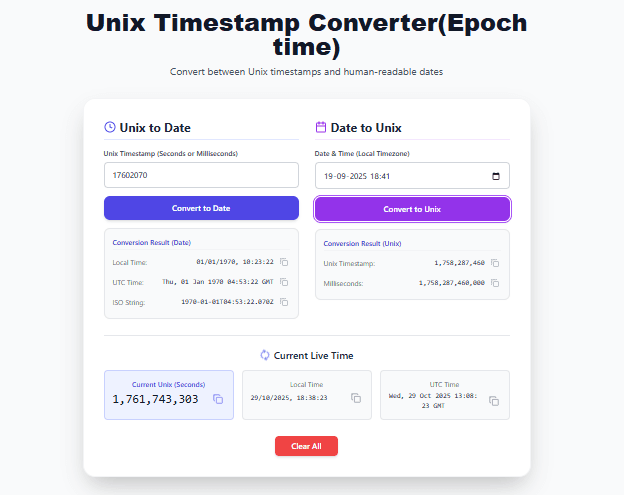
Computers often store time as the number of seconds since 1970-01-01 00:00:00 UTC. This is called Unix timestamp.
Example: 1696516200 (this represents 2025-10-05 14:30:00 UTC)
Daylight Saving Time and UTC
Daylight saving time (DST) temporarily changes a region's UTC offset. Understanding DST is essential for correct UTC conversion.
What is Daylight Saving Time?
DST is the practice of moving clocks forward by 1 hour in spring and back by 1 hour in autumn. This extends evening daylight during warmer months.
How DST Affects UTC Offsets
| Location | Standard Offset | DST Offset | DST Period |
|---|---|---|---|
| New York | UTC -5 | UTC -4 | March to November |
| London | UTC +0 | UTC +1 | March to October |
| Paris | UTC +1 | UTC +2 | March to October |
| Sydney | UTC +10 | UTC +11 | October to April |
Which Countries Do Not Observe DST?
Many countries do not observe daylight saving time. This includes:
- India (UTC +5:30 year round)
- China (UTC +8 year round)
- Japan (UTC +9 year round)
- Most countries near the equator
DST Conversion Example
Scenario: It is July (summer in northern hemisphere). You are in New York (UTC -4 during DST). You want to convert 18:00 UTC to New York time.
Calculation: 18:00 - 4 = 14:00 (2 PM)
If it were January (winter, no DST), New York would be UTC -5: Calculation: 18:00 - 5 = 13:00 (1 PM)
The same UTC time converts to different local times depending on DST.
UTC to Local Time Conversion Table
Use this table as a quick reference. It assumes standard time (no DST).
| UTC Time | New York (UTC-5) | London (UTC+0) | India (UTC+5:30) | Tokyo (UTC+9) |
|---|---|---|---|---|
| 00:00 | 19:00 (previous day) | 00:00 | 05:30 | 09:00 |
| 01:00 | 20:00 (previous day) | 01:00 | 06:30 | 10:00 |
| 02:00 | 21:00 (previous day) | 02:00 | 07:30 | 11:00 |
| 03:00 | 22:00 (previous day) | 03:00 | 08:30 | 12:00 |
| 04:00 | 23:00 (previous day) | 04:00 | 09:30 | 13:00 |
| 05:00 | 00:00 | 05:00 | 10:30 | 14:00 |
| 06:00 | 01:00 | 06:00 | 11:30 | 15:00 |
| 07:00 | 02:00 | 07:00 | 12:30 | 16:00 |
| 08:00 | 03:00 | 08:00 | 13:30 | 17:00 |
| 09:00 | 04:00 | 09:00 | 14:30 | 18:00 |
| 10:00 | 05:00 | 10:00 | 15:30 | 19:00 |
| 11:00 | 06:00 | 11:00 | 16:30 | 20:00 |
| 12:00 | 07:00 | 12:00 | 17:30 | 21:00 |
| 13:00 | 08:00 | 13:00 | 18:30 | 22:00 |
| 14:00 | 09:00 | 14:00 | 19:30 | 23:00 |
| 15:00 | 10:00 | 15:00 | 20:30 | 00:00 (next day) |
| 16:00 | 11:00 | 16:00 | 21:30 | 01:00 (next day) |
| 17:00 | 12:00 | 17:00 | 22:30 | 02:00 (next day) |
| 18:00 | 13:00 | 18:00 | 23:30 | 03:00 (next day) |
| 19:00 | 14:00 | 19:00 | 00:30 (next day) | 04:00 (next day) |
| 20:00 | 15:00 | 20:00 | 01:30 (next day) | 05:00 (next day) |
| 21:00 | 16:00 | 21:00 | 02:30 (next day) | 06:00 (next day) |
| 22:00 | 17:00 | 22:00 | 03:30 (next day) | 07:00 (next day) |
| 23:00 | 18:00 | 23:00 | 04:30 (next day) | 08:00 (next day) |
How to Use Our UTC Converter
Our UTC converter tool makes time zone conversion instant.
Step 1: Enter the UTC time you want to convert
Step 2: Select the target time zone
Step 3: The tool automatically accounts for daylight saving time
Step 4: See the converted local time instantly
Step 5: Copy the result for sharing
No manual calculations. No worrying about DST. Just enter and get the answer.
Frequently Asked Questions
Q: What is UTC in simple terms?
A: UTC is the world's time standard. All time zones are defined by how many hours they are ahead of or behind UTC.
Q: What is the difference between UTC and GMT?
A: GMT is based on Earth's rotation. UTC is based on atomic clocks. For most practical purposes, they are the same. But UTC is the modern scientific standard.
Q: What is a UTC offset?
A: A UTC offset is the difference between local time and UTC. For example, India is UTC +5:30, meaning local time is 5 hours 30 minutes ahead of UTC.
Q: How to convert UTC to local time?
A: Add or subtract your UTC offset from UTC time. For example, if UTC is 12:00 and you are UTC +5:30, local time is 17:30. Use our UTC converter for instant results.
Q: Does UTC change for daylight saving time?
A: No. UTC never changes. Local time zones change their offset during daylight saving time. UTC remains constant.
Q: Why are some UTC offsets 30 or 45 minutes?
A: Some countries chose offsets that align with their geographic position or historical preferences. India (UTC +5:30), Iran (UTC +3:30), and Nepal (UTC +5:45) are examples.
Q: What is Zulu time?
A: Zulu time is another name for UTC. It is used in aviation and military contexts. Zulu is the NATO phonetic alphabet word for Z, which stands for zero offset.
Q: What is a UTC timestamp?
A: A UTC timestamp is the number of seconds since 1970-01-01 00:00:00 UTC. It is used in computer systems for storing time.
Q: How to get current UTC time?
A: Use our UTC converter tool. It shows a live UTC clock updated every second.
Q: Why does UTC use leap seconds?
A: Earth's rotation is gradually slowing. Leap seconds keep UTC aligned with solar time. Without them, UTC would slowly drift ahead of the sun.
Q: How many leap seconds have been added?
A: 27 leap seconds have been added since 1972. The last one was added on December 31, 2016.
Q: Does my phone use UTC?
A: Your phone uses UTC internally. It converts UTC to your local time based on your time zone and DST settings.
Q: What is the best free UTC converter?
A: Our UTC converter is completely free, handles DST automatically, and works on all devices.
Q: How to schedule international meetings using UTC?
A: Agree on a UTC time for the meeting. Each participant converts UTC to their local time using their UTC offset. This prevents confusion.
Q: Is UTC the same worldwide?
A: Yes. UTC is the same everywhere. 12:00 UTC in New York is the same moment as 12:00 UTC in Tokyo.
Fun Facts About UTC
- The name UTC is a compromise between English (CUT - Coordinated Universal Time) and French (TUC - Temps Universel Coordonné).
- UTC never changes for daylight saving time. It stays the same all year.
- GPS satellites have atomic clocks that maintain UTC with incredible precision.
- Leap seconds have been added 27 times since 1972. The first leap second was added on June 30, 1972.
- The International Space Station uses UTC.
- UTC is sometimes called "Zulu time" in aviation and military contexts.
- The Prime Meridian (0 degrees longitude) in Greenwich, London is the reference point for UTC.
My Final Advice
After years of working with UTC across different projects, here is what I have learned.
Use UTC for all timestamps in databases and APIs. It is the standard for a reason. Using local time in your database will cause problems when servers move time zones or when daylight saving time changes.
Always check DST status before converting. The same location can have different UTC offsets depending on the time of year. Forgetting DST is the most common conversion mistake.
Use a tool for conversions. Manual conversion is fine for simple cases, but when you have multiple time zones or DST involved, use a reliable converter. Our tool handles everything automatically.
Remember minute offsets. Not all time zones use whole hours. India, Iran, Afghanistan, and Nepal have minute offsets. Account for them.
Think in UTC for international scheduling. When planning meetings with people in different time zones, think in UTC. Find a UTC time that works for everyone, then convert to local times.
And finally, use a good UTC converter. It saves time, prevents mistakes, and works for any time zone in the world.
Try Our Free UTC Converter Now
Have questions about UTC for a specific use case? Leave a comment below. I try to answer every one.
Tags: what is utc, utc time explained, coordinated universal time, utc vs gmt difference, utc time zone, utc offset explained, world time zones, how utc works, utc converter online, gmt vs utc, utc time now, utc time format, utc timestamp, why utc is important, utc for beginners, utc for developers, utc for travelers, time synchronization, leap seconds explained, utc history, utc vs local time, how to convert utc to local time, utc time zone list, utc offset by country, daylight saving time explained, utc in aviation, utc in finance, utc in technology